Tuesday, April 23, 2019

Blueshift announces $15M Series B to expand AI-fueled cross-channel marketing tool

Blueshift is startup founded by tech industry veterans, who saw first-hand how difficult cross-channel marketing was. They decided to launch a company and build a cross-channel marketing platform from the ground up that uses AI and machine learning to make sense of the growing amount of customer data. Today, the startup announced a $15 million Series B round to keep it going.

The round was led by Softbank Ventures Asia, a fund focused on AI startups like Blueshift. Previous investors Storm Ventures and Nexus Venture Partners also participated. Today’s investment brings the total raised to $30 million, according the company.

Company co-founder and CEO Vijay Chittoor says the marketing landscape is changing, and he believes that requires a new approach to allow marketers to take advantage of the multiple channels where they could be engaging with customers from a single tool.

“If you thought about the world of customer engagement at Walmart or Groupon [or any other retailer] 10 years ago, it was primarily an email problem. Today, we as customers, we’re interacting with these brands on not just email, but also on mobile notifications, Facebook custom audiences and WeChat [and across multiple other channels],” he explained.

He says that this has created a lot more data, which it turns out is a double-edged sword for marketing pros. “I think on one end, it’s exciting for a marketer or a CMO to have more data and more channels. It gives them more ways to connect. But at the same time, it’s also more challenging because now you have to make sense of thousand times more data. And you have to use it intelligently on not just one channel like email, but you’re now trying to make sense of data across 15 different channels,” Chittoor said.

This a crowded field with big players like Adobe, Salesforce and Oracle, among others, offering similar cross-channel, AI-fueled solution. In addition startups are attracting huge chunks of money to attack this problem, including Klayvio pulling in $150 million a couple of weeks ago and Iterable, which landed $50 million last month.

He says his company’s differentiator is the AI piece, and it is this piece that the company’s lead investor in this round has been focusing on in its investments. The company plans to use this round to continue building out its marketing platform and show marketers how to communicate intelligently across channels wherever the consumer happens to be. Customers include LendingTree, Udacity and BBC.

Harness hauls in $60M Series B investment on $500M valuation

Series B rounds used to be about establishing a product-market fit, but for some startups the whole process seems to be accelerating. Harness, the startup founded by AppDynamics co-founder and CEO Jyoti Bansal is one of those companies that is putting the pedal the metal with his second startup, taking his learnings and a $60 million round to build the company much more quickly.

Harness already has an eye-popping half billion dollar valuation. It’s not terribly often I hear valuations in a Series B discussion. More typically CEOs want to talk growth rates, but Bansal volunteered the information, excited by the startup’s rapid development.

The round was led by IVP, GV (formerly Google Ventures) and ServiceNow Ventures. Existing investors Big Labs, Menlo Ventures and Unusual Ventures also participated. Today’s investment brings the total raised to $80 million, according to Crunchbase data.

Bansal obviously made a fair bit of money when he sold AppDynamics to Cisco in 2017 for $3.7 billion and he could have rested after his great success. Instead he turned his attention almost immediately to a new challenge, helping companies move to a new continuous delivery model more rapidly by offering Continuous Delivery as a Service.

As companies move to containers and the cloud, they face challenges implementing new software delivery models. As is often the case, large web scale companies like Facebook, Google and Netflix have the resources to deliver these kinds of solutions quickly, but it’s much more difficult for most other companies.

Bansal saw an opportunity here to package continuous delivery approaches as a service. “Our approach in the market is Continuous Delivery as a Service, and instead of you trying to engineer this, you get this platform that can solve this problem and bring you the best tooling that a Google or Facebook or Netflix would have,” Basal explained.

The approach has gained traction quickly. The company has grown from 25 employees at launch in 2017 to 100 today. It boasts 50 enterprise customers including Home Depot, Santander Bank and McAfee.

He says that the continuous delivery piece could just be a starting point, and the money from the round will be plowed back into engineering efforts to expand the platform and solve other problems DevOps teams face with a modern software delivery approach.

Bansal admits that it’s unusual to have this kind of traction this early, and he says that his growth is much faster than it was at AppDynamics at the same stage, but he believes the opportunity here is huge as companies look for more efficient ways to deliver software. “I’m a little bit surprised. I thought this was a big problem when I started, but it’s an even bigger problem than I thought and how much pain was out there and how ready the market was to look at a very different way of solving this problem,” he said.

Thursday, April 18, 2019

Microsoft delves deeper into IoT with Express Logic acquisition

Microsoft has never been shy about being acquisitive, and today it announced it’s buying Express Logic, a San Diego company that has developed a real-time operating system (RTOS) aimed at controlling the growing number of IoT devices in the world.

The companies did not share the purchase price.

Express Logic is not some wide-eyed, pie-in-the-sky startup. It has been around for 23 years building (in its own words), “industrial-grade RTOS and middleware software solutions for embedded and IoT developers.” The company boasts some 6.2 billion (yes, billion) devices running its systems. That number did not escape Sam George, director of Azure IoT at Microsoft, but as he wrote in a blog post announcing the deal, there is a reason for this popularity.

“This widespread popularity is driven by demand for technology to support resource constrained environments, especially those that require safety and security,” George wrote.

The beauty of Express Logic’s approach is that it can work in low-power and low resource environments and offers a proven solution for a range or products. “Manufacturers building products across a range of categories — from low capacity sensors like lightbulbs and temperature gauges to air conditioners, medical devices and network appliances  –leverage the size, safety and security benefits of Express Logic solutions to achieve faster time to market,” George wrote.

Writing in a blog post to his customers announcing the deal, Express Logic CEO William E. Lamie, expressed optimism that the company can grow even further as part of the Microsoft family. “Effective immediately, our ThreadX RTOS and supporting software technology, as well as our talented engineering staff join Microsoft. This complements Microsoft’s existing premier security offering in the microcontroller space,” he wrote.

Microsoft is getting an established company with a proven product that can help it scale its Azure IoT business. The acquisition is part of a $5 billion investment in IoT the company announced last April that includes a number of Azure pieces such as Azure Sphere, Azure Digital Twins, Azure IoT Edge, Azure Maps and Azure IoT Central.

“With this acquisition, we will unlock access to billions of new connected endpoints, grow the number of devices that can seamlessly connect to Azure and enable new intelligent capabilities. Express Logic’s ThreadX RTOS joins Microsoft’s growing support for IoT devices and is complementary with Azure Sphere, our premier security offering in the microcontroller space,” George wrote.

CloudBees acquires Electric Cloud to build out its software delivery management platform

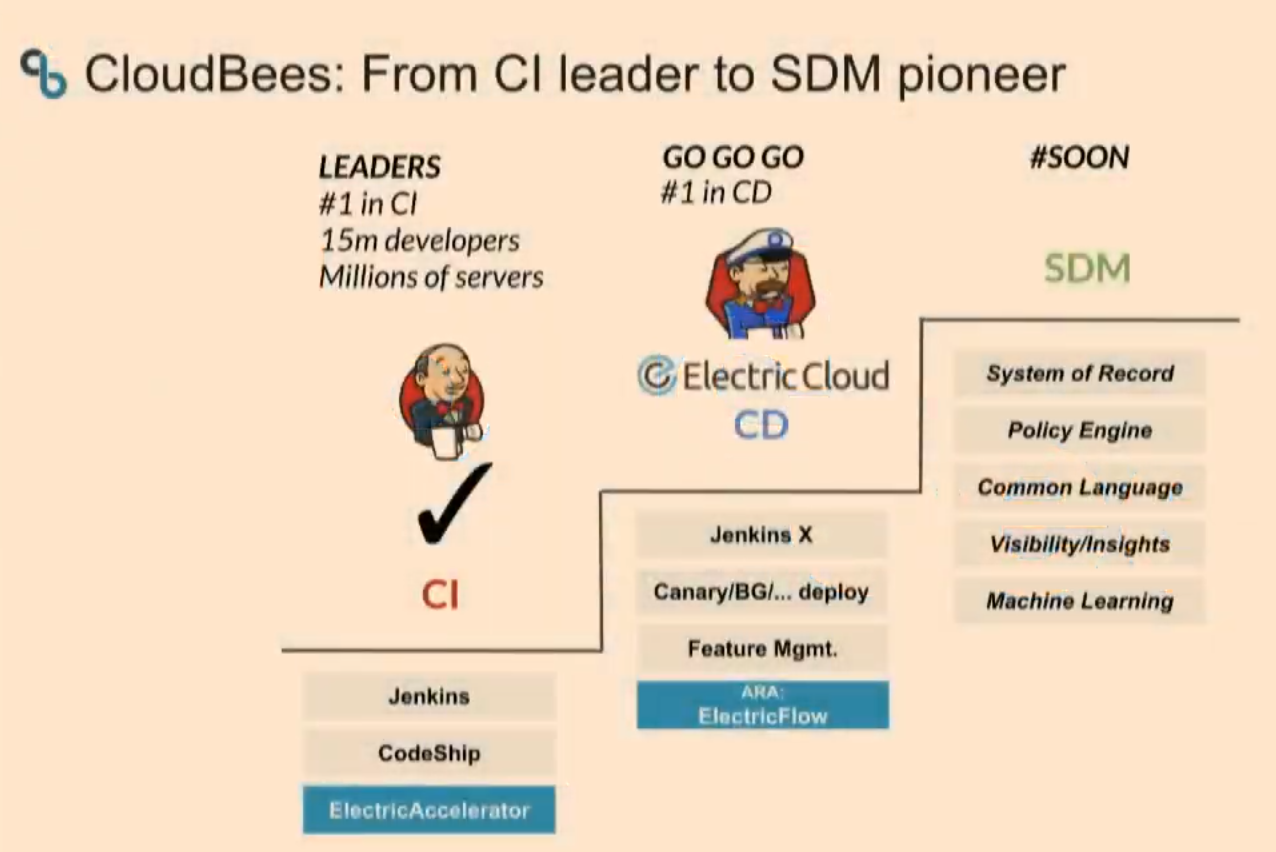
CloudBees, the enterprise continuous integration and delivery service (and the biggest contributor to the Jenkins open-source automation server), today announced that it has acquired Electric Cloud, a continuous delivery and automation platform that first launched all the way back in 2002.

The two companies did not disclose the price of the acquisition, but CloudBees has raised a total of $113.2 million while Electric Cloud raised $64.6 million from the likes of  Rembrandt Venture Partners, U.S. Venture Partners, RRE Ventures and Next47.

CloudBees plans to integrate Electric Cloud’s application release automation platform into its offerings. Electric Flow’s 110 employees will join CloudBees.

“As of today, we provide customers with best-of-breed CI/CD software from a single vendor, establishing CloudBees as a continuous delivery powerhouse,” said Sacha Labourey, the CEO and co-founder of CloudBees, in today’s announcement. “By combining the strength of CloudBees, Electric Cloud, Jenkins and Jenkins X, CloudBees offers the best CI/CD solution for any application, from classic to Kubernetes, on-premise to cloud, self-managed to self-service.”

Electric Cloud offers its users a number of tools for automating their release pipelines and managing the application lifecycle afterward.

“We are looking forward to joining CloudBees and executing on our shared goal of helping customers build software that matters,” said Carmine Napolitano, CEO, Electric Cloud. “The combination of CloudBees’ industry-leading continuous integration and continuous delivery platform, along with Electric Cloud’s industry-leading application release orchestration solution, gives our customers the best foundation for releasing apps at any speed the business demands.”

As CloudBees CPO Christina Noren noted during her keynote at CloudBees’ developer conference today, the company’s customers are getting more sophisticated in their DevOps platforms, but they are starting to run into new problems now that they’ve reached this point.

“What we’re seeing is that these customers have disconnected and fragmented islands of information,” she said. “There’s the view that each development team has […] and there’s not a common language, there’s not a common data model, and there’s not an end-to-end process that unites from left to right, top to bottom.” This kind of integrated system is what CloudBees is building toward (and that competitors like GitLab would argue they already offer). Today’s announcement marks a first step into this direction toward building a full software delivery management platform, though others are likely to follow.

During his company’s developer conference, Labourey also today noted that CloudBees will profit from Electric Cloud’s long-standing expertise in continuous delivery and that the acquisition will turn CloudBees into a “DevOps powerhouse.”

Today’s announcement follows CloudBees’ acquisition of CI/CD tool CodeShip last year. As of now, CodeShip remains a stand-alone product in the company’s lineup. It’ll be interesting to see how CloudBees will integrate Electric Cloud’s products to build a more integrated system.


Spotinst, the startup enabling companies to purchase and manage excess cloud capacity, acquires StratCloud

Spotinst, the cloud automation and optimization startup founded in Tel Aviv but now with offices in San Francisco, New York, and London too, has acquired AWS partner StratCloud. Terms of the deal remain undisclosed, although I’m hearing it combines both cash and stock and was somewhere in the region of $5 million.

As part of the acquisition, StratCloud’s team of 15 people will be joining Spotinst, including founder Patrick Gartlan, who will become VP, Cloud Services at Spotinst. StratCloud hadn’t raised any venture capital but instead was bootstrapped by Gartlan, who was the former CTO of Cloud Optimization company CloudCheckr.

Founded in 2015, Spotinst enables enterprises to optimize their cloud infrastructure usage by automating the process of using excess — and therefore cheaper — capacity from leading cloud providers.

As TechCrunch’s Ron Miller previously explained, cloud platforms like AWS, Microsoft Azure and Google Cloud Platform, all of which Spotinst supports, have to maintain more resources than they need at any given time. All three companies offer steep discounts to customers who want to access these resources, but they come with a strict condition that the platforms can take those resources back whenever they need them. Which is where Spotinst (and today’s acquisition of StratCloud) comes in.

Spotinst’s platform manages the process of acquiring spare capacity, powered by predictive AI, and seamlessly switches providers before it’s withdrawn. This ensures that cloud computing “workloads” keep functioning, while the customer still receives the best possible price.

Meanwhile, StratCloud tech is described as an “optimization platform” that buys, sells and converts reserved capacity, therefore maximizing savings for on-demand infrastructure. “This leads to lower compute payments, without engineers having to change anything in the applications and infrastructure they manage,” explains Spotinst.

Related to this, Spotinst will migrate StratCloud’s several dozen customers to the Spotinst Platform where they’ll continue to receive all of the current functionality.

Overall, the acquisition means Spotinst can now offer a complete solution for cloud users, including offering reserved instances and unused computer power so that enterprises can run any workload and support large-scale migrations on any cloud provider. In addition, Spotinst says the combined technologies give Managed Service Providers (MSPs) a comprehensive tool to optimize cloud workloads for all of their managed customers.

Spotinst claims over 1,500 enterprise customers in 52 countries, including Samsung, N26, Duolingo, Ticketmaster and Wix. The company currently employs approximately 150 staff across its four offices and has raised $52 million in VC funding to date.

Wednesday, April 17, 2019

Salesforce is buying MapAnything, a startup that raised over $84 million

Salesforce announced today it’s buying another company built on its platform. This time it’s MapAnything, which as the name implies, helps companies build location-based workflows, something that could come in handy for sales or service calls.

The companies did not reveal the selling price, and Salesforce didn’t have anything to add beyond a brief press release announcing the deal.

“The addition of MapAnything to Salesforce will help the world’s leading brands accurately plan: how many people they need, where to put them, how to make them as productive as possible, how to track what’s being done in real time and what they can learn to improve going forward,” Salesforce wrote in the statement announcing the deal.

It was a logical acquisition on many levels. In addition to being built on the Salesforce platform, the product was sold through the Salesforce AppExchange, and over the years MapAnything has been a Salesforce SI Partner, an ISV Premier Partner, according the company.

“Salesforce’s pending acquisition of MapAnything comes at a critical time for brands. Customer Experience is rapidly overtaking price as the leading reason companies win in the market. Leading companies like MillerCoors, Michelin, Unilever, Synchrony Financial and Mohawk Industries have all seen how location-enabled field sales and service professionals can focus on the right activities against the right customers, improving their productivity, and allowing them to provide value in every interaction,” company co-founder and CEO John Stewart wrote in a blog post announcing the deal.

MapAnything boasts 1900 customers in total, and that is likely to grow substantially once it officially becomes part of the Salesforce family later this year.

MapAnything was founded in 2009, so it’s been around long enough to raise over $84 million, according to Crunchbase. Last year, we covered the company’s $33.1 million Series B round, which was led by Columbus Nova.

At the time of the funding CEO John Stewart told me that his company’s products present location data more logically on a map instead of in a table. ‘“Our Core product helps users (most often field-based sales or service workers) visualize their data on a map, interact with it to drive productivity, and then use geolocation services like our mobile app or complex routing to determine the right cadence to meet them,” Stewart told me last year.

It raised an additional $42.5 million last November. Investors included General Motors Ventures and (unsurprisingly) Salesforce Ventures.

Google Cloud brings on 27-year SAP veteran as it doubles down on enterprise adoption

Thomas Kurian, the newly-minted CEO of Google Cloud, used the company’s Cloud Next conference last week to lay out his vision for the future of Google’s cloud computing platform. That vision involves, in part, a hiring spree to give businesses that want to work with Google more people to talk to and get help from. Unsurprisingly, Kurian is also looking to put his stamp on the executive team, too, and today announced that former SAP executive Robert Enslin is joining Google Cloud as its new President of Global Customer Operations.

Enslin’s hire is another clear signal that Kurian is focused on enterprise customers. Enslin, after all, is a veteran of the enterprise business, with 27 years at SAP, where he served on the company’s executive board until he announced his resignation from the company earlier this month. After leading various parts of SAP, including as president of its cloud product portfolio, president of SAP North America and CEO of SAP Japan, Enslin announced that he had “a few more aspirations to fulfill.” Those aspirations, we now know, include helping Google Cloud expand its lineup of enterprise customers.

“Rob brings great international experience to his role having worked in South Africa, Europe, Asia and the United States—this global perspective will be invaluable as we expand Google Cloud into established industries and growth markets around the world,” Kurian writes in today’s announcement.

For the last two years, Google Cloud already had a President of Global Customer Operations, though, in the form of Paul-Henri Ferrand, a former Dell exec who was brought on by Google Cloud’s former CEO Diane Greene. Kurian says that Ferrand “has decided to take on a new challenge within Google.”