Wednesday, December 12, 2018

Tigera raises $30M Series B for its Kubernetes security and compliance platform

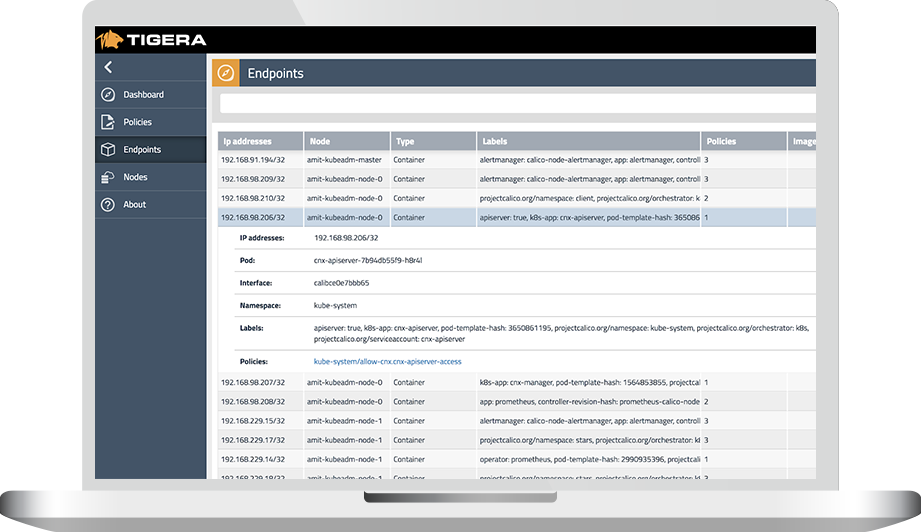
Tigera, a startup that offers security and compliance solutions for Kubernetes container deployments, today announced that it has raised a $30 million Series B round led by Insight Partners. Existing investors Madrona, NEA and Wing also participated in this round.

Like everybody in the Kubernetes ecosystem, Tigera is exhibiting at KubeCon this week, so I caught up with the team to talk about the state of the company and its plans for this new raise.

“We are in a very exciting position,” Tigera president and CEO Ratan Tipirneni told me. “All the four public cloud players [AWS, Microsoft Azure, Google Cloud and IBM Cloud] have adopted us for their public Kubernetes service. The large Kubernetes distros like Red Hat and Docker are using us.” In addition, the team has signed up other enterprises, often in the healthcare and financial industry, and SaaS players (all of which it isn’t allowed to name) that use its service directly.

The company says that it didn’t need to raise right now. “We didn’t need the money right now, but we had a lot of incoming interest,” Tipirneni said. The company will use the funding to expand its engineering, marketing and customer success teams. In total, it plans to quadruple its sales force. In addition, it plans to set up a large office in Vancouver, Canada, mostly because of the availability of talent there.

In the legacy IT world, security and compliance solutions could rely on the knowledge that the underlying infrastructure was relatively stable. Now, though, with the advent of containers and DevOps, workloads are highly dynamic, but that also makes the challenge of securing them and ensuring compliance with regulations like HIPAA or standards like PCI more complex, too. The promise of Tigera’s solution is that it allows enterprises to ensure compliance by using a zero-trust model that authorizes each service on the network, encrypts all the traffic and enforces the policies the admins have set for their company and needs. All of this data is logged in detail and, if necessary, enterprises can pull it for incident management or forensic analysis. 

AI-powered knowledge sharing platform Guru raises $25 million Series B

Guru, the enterprise-focused information sharing platform, has today announced the close of a $25 million Series B funding led by Thrive Capital, with participation from existing investors Emergence Capital, FirstMark Capital, Slack Fund, and Michael Dell’s MSD Capital.

Guru came on to the scene in 2013 with the premise that organizations are not so great at building out informational databases, nor are they very good at using them. So Guru built a Chrome extension that simply sits as a layer on employees’ computers and surfaces the right information whenever asked.

Specifically, this comes in handy for customer service agents and sales people who need to answer questions from people outside of the organization quickly and accurately.

This summer, Guru revamped the platform to incorporate a new feature set called AI Suggest. The feature simply auto-surfaces relevant information as the employee goes about their business, with no searches or inquiries necessary. The company also unveiled two different versions of the feature, text and voice, so that it is still useful when employees are on the phone.

Companies that are sensitive about their information being shared with Guru can customize the level of access given to Guru, including or excluding certain third-party integrations etc., as well as how long information is stored on Guru. No personally identifying information about end-customers is ever stored on the Guru platform.

Over the past couple years, Guru has brought on big-name clients including BuzzFeed, Glossier, Intercom and Thumbtack.

Guru has signed on 200 new clients since the launch of AI Suggest in July, with a total of around 800 companies on the platform, representing thousands of users.

For now, the company is hyper focused on growth.

“We are not profitable yet,” said cofounder and CEO Rick Nucci.” But we’re intentionally focused on growth. What prompted us to raise this round right now is to continue to execute on the momentum of the business.”

Guru has now raised a total of $27.5 million.

AtScale lands $50 million investment led by Morgan Stanley

AtScale, the startup that helps companies move massive amounts of data into business intelligence and analytics tools, announced a $50 million Series D round today.

Morgan Stanley led the round with previous investors Storm Ventures and Atlantic Bridge joining in. New investor Wells Fargo also participated. The funding comes almost exactly a year after the company announced its $25 million Series C. Today’s funding brings the total amount raised to $120 million.

Bringing on an institutional investor like Morgan Stanley is often a signal that the company has reached the stage where it is at least beginning to think about the possibility of going public at some point in the future. AtScale CEO Chris Lynch acknowledged such a connection without making any broad commitment (as you would expect). “We are not close to being IPO-ready, but that was a future consideration in selecting Morgan Stanley,” Lynch told TechCrunch.

What the company does is help take big data and move it into tools where customers can make better use of it. AtScale co-founder Dave Mariani used to be at Yahoo where he helped pioneer the use of big data in the 2009/2010 timeframe. Unfortunately, systems at the time couldn’t deal with the volume of data and that is still a problem, one that AtScale says it is designed to solve. “We take a bunch of data silos and put a semantic layer across the data platforms and expose them in a consistent way,” Mariani told TechCrunch last year at the time of the Series C round. This allows company to get a big picture view of their data, rather than consuming it smaller chunks.

AtScale reported a banner year bringing on 50 new customers across their target verticals of retail, financial services, advertising and digital sales. These include Rakuten, Dell Technologies, TD Bank and Toyota. What’s more, the company stretched out this year, taking advantage of the last funding round to expand more into international markets in Europe and Asia.

The company was founded in 2013 and is based in San Mateo, California.

Software marketplace G2 Crowd acquires Siftery to fold software usage into its dataset

After raising $55 million in October at a $500 million valuation, business software marketplace G2 Crowd is making its first-ever acquisition to bring more features to its platform. It is acquiring Siftery, a startup that has built its own database of business software not on user reviews, but by providing a service to businesses where it identifies what is actually getting used and when across their networks.

Terms of the deal are not being disclosed, G2 Crowd’s CEO and founder Godard Abel said in an interview. Siftery had been around for a couple of years and had raised a seed round of $4.1 million from a group of notable investors, including Founders Fund, Felicis and Venrock. All 20 employees, including co-founders CEO Vamshi Mokshagundam and CTO Ayan Barua, are joining G2 Crowd.

G2 Crowd has been building a name for itself as a place where IT buyers can discover and buy software and services for solving specific issues; and if they already are already using or considering a product, a place where they can read other’s reviews and compare it against competitors.

There are some 550,000 reviews on the site today across nearly 60,000 products in 1,200 categories (those reviews are up by 50,000 in the last two months). Around 2 million business professionals visit and use the site each month, which they may go to because they are repeat users, or because G2 Crowd happens to have a very strong SEO game, with its links turning up at the top of the list when you do a search for a specific product or product category.

That economy of scale makes G2 Crowd a pretty logical home for Siftery, which had also provided a database of software for businesses, but at a much smaller scale and before it had been truly commercialised. Abel said that the startup had only around 1,500 customers, with most of them on a free version of the product.

“They were just getting to the point where there was a fork in the road,” he added. “What they hadn’t done yet is monetise and build a business, and we are product people at G2 Crowd.”

This also seems to be the stated logic for Siftery, too. “We’re excited to join the G2 Crowd team so we can more quickly realize our joint vision,” said Vamshi Mokshagundam, co-founder and CEO of Siftery, in a statement. “By becoming part of the G2 family, Siftery’s technology can reach millions more people, continue to develop rapidly, and have a bigger impact around the world in helping to eliminate wasted and inefficient software spend.”

Siftery’s additional functionality is interesting in terms of how G2 Crowd will develop going forward.

The smaller startup engaged with customers and their networks and provided insight into how much each product or service is actually getting used (not just enthused). That makes a handy way to determine whether money was being wasted on licenses for certain apps; or conversely whether companies are suffering from “shadow IT”: overpaying by not consolidating their purchasing and bargaining power. All that data subsequently also helped to provide insight to people searching its database to discover software.

The problem of overspending on software and apps happens to be a big one. G2 Crowd cites data from Netskope which estimates that the average enterprise now runs 1,246 cloud services, a figure that is growing over 10% each year. At the small business end, Siftery estimates that the average organization had 55 SaaS tools, more than doubling over the last three years.

And the challenge is still growing: across the range of company sizes, 35 percent more software gets trialled each year, with software budgets growing by 50 percent year-on-year for the past four. Some $1.4 trillion was spent on software and services last year, with waste in the UK and US collectively estimated at $34 billion, G2 Crowd said.

Abel said that for now the idea will be to keep Siftery’s product separate while it gets gradually integrated into G2 Crowd. There, it will potentially give the company another string in its bow in terms of the services it offers to businesses coming to its platform — and opting for paid usage tiers.

Interestingly, while G2 Crowd will likely continue to be popular as a marketplace to search for apps and services, this deal underscores how the company hopes to develop going forward. It has the opportunity to build a platform where organizations can manage their software, and potentially provide further tools to optimise how it is used, plan more deployments connected to it, and so on.

Abel has a long history building and selling startups focused around software productivity (most recently to Salesforce, but also to Oracle and before that CA), and that appears to be the direction he’s taking G2 Crowd, too. (Indeed, it seems to be part of a mini-wave of tech startups rethinking how businesses interact with software. Just earlier today, Nexthink out of Switzerland raised $85 million for its solution that helps enterprises monitor, triage and assist employees who encounter annoying software issues.)

Abel said that the engineering talent at Siftery was also a big attraction, and that could help shape other acquisitions going forward.

“I think we will look opportunistically,” he said. “It depends on finding a strong product and team.”

Juniper Square lines up $25M for its real estate investment platform

Juniper Square, a four-year-old startup at the intersection of enterprise software, real estate and financial technology, has brought in an additional $25 million in Series B funding to fuel the growth of its commercial real estate investment platform. Ribbit Capital led the round, with participation from Felicis Ventures.

Founded in 2014 by Alex Robinson, Yonas Fisseha and Adam Ginsburg, the startup’s chief executive officer, vice president of engineering and VP of product, respectively, Juniper has raised a total of $33 million to date.

The company operates a software platform for commercial real estate investment firms — an industry that has been slower to adopt the latest and greatest technology. Robinson tells TechCrunch those firms raise money from pension funds, endowments and elsewhere to purchase and then manage commercial real estate, using Juniper’s software as a tool throughout that process. Juniper supports fundraising and capital management with a suite of customer relationship management (CRM) and productivity tools for its users.

The San Francisco-based company says it currently has hundreds of customers and manages half a trillion dollars in real estate.

“The private markets are just as big as the public markets … but the private markets have typically not been accessible to everyday investors, and that’s part of what we are trying to do with Juniper Square,” Robinson told TechCrunch. “It’s a tremendously large market that almost nobody knows anything about.”

Juniper will use its latest investment to double headcount from 60 to 120 in the year ahead, with plans to beef up its engineering, product and sales teams specifically as the company expects to continue experiencing massive growth. Robinson said it’s grown between 3x and 4x every year for the last three years.

Felicis Ventures managing director Sundeep Peechu said in a statement that Juniper “is one of the fastest growing real estate tech companies” the firm has ever seen: “They are building technology for an industry that touches nearly every human and every corner of the economy. It’s a hard problem that takes time to solve, but the benefits of making these huge markets work better are tremendous.”

Existing in a relatively niche intersection, Juniper’s job now is to prove itself more efficient and user-friendly than Microsoft Excel spreadsheets, which, Robinson says, are still its biggest competitor.

“Our goal is to be the de facto platform for real estate investment and we are well on our way to becoming that.”

Nexthink raises $85M to monitor and improve ’employee experience’ of apps

As companies compete for talent, a startup that has built a platform to help ensure that the talent — once it’s working for you — doesn’t get bogged down by IT frustration, has raised a significant round of funding.

Lausanne, Switzerland-based Nexthink has nailed down $85 million in funding led by Index Ventures (which has a base in nearby Geneva), with participation also from Highland Europe, Forestay Capital, Galéo Capital and TOP Funds and Olivier Pomel (co-founder and CEO of Datadog).

Nexthink’s CEO Pedro Bados said in an interview that the company will be using this round to expand its business globally and specifically in the US.

It will be doing this from a healthy base. The company already has 900 enterprise customers, covering no less than 7 million endpoints, using its platform to improve employees’ interaction and satisfaction with the IT tools that they are required to use for work. Customers include Adobe, Advocate Healthcare, BlackRock, Commerzbank, Safran, Sega HARDlight, Tiffany & Co., Vitality, Wipro and Western Union.

Network monitoring is a big and established area in the world of IT, where tech companies provide a wide array of solutions to identify and potentially fix network glitches across on-premise, cloud and hybrid environments.

What is only becoming more apparent now to organizations is that problems with the dozens of apps and other software that employees need to use can be just as much, if not more, of an issue, when it comes to getting work done — for example, because something is not working in the app, the worker is unsure how to do something, or there is a configuration issue.

That is the issue that Nexthink is tackling. The company installs a widget — it calls it a Collector — on a worker’s phone, tablet, laptop, desktop computer, or whatever device is being used. That Collector in turn monitors hundreds of metrics around how you are using your device, ranging from performance issues and policy breaches through to examining what software is being used, and what is not.

Nexthink’s algorithms both identify and even can anticipate when a problem is happening, and either provide a quick suggestion to fix it, or provide the right data to the IT team to help solve the problem.

In the “marketplace” created in an IT network, you might think of Nexthink as solving problems at two ends: for the IT team, reduces the number of calls it gets by helping solve problems and providing useful information in cases where they will really be needed. For the employees, it gives them a quick and hopefully helpful response so that they can get on with their work.

“Not only are employees happy and more productive, but costs go down on support,” Bados says.

Nexthink has actually been around for 14 years — Bados co-founded Patrick Hertzog andVincent Bieri not long after he finished his graduate research work in artificial intelligence at the polytechnic in Lausanne — and this latest round is larger than all the funding that the company had raised up to now, which had been $69 million.

That in itself is a sign of how VCs and the industry are waking up to the opportunity to address the challenge of software usability and experience and how that might affect employee satisfaction and productivity.

“We’ve known the company for a while and have a lot of respect for Pedro as a CEO,” said Neil Rimer of Index Ventures in an interview. “Watching what they have been buildingn focusing on user experience and management, is an area that we find compelling.” Plus the customer caliber and loyalty helped, he said. “The retention and lack of churn are all very impressive.”

Unsurprisingly, there are a number of others also moving into the same space as Nexthink, including Microsoft, VMware and Riverbed, as well as others like New Relic around the same neighborhood of services. For now, Bados says he sees these more as potential partners than rivals.

Tuesday, December 11, 2018

Dell’s long game is in hybrid and private clouds

When Dell voted to buy back the VMware tracking stock and go public again this morning, you had to be wondering what exactly the strategy was behind these moves. While it’s clearly about gaining financial flexibility, the $67 billion EMC deal has always been about setting the company up for a hybrid and private cloud future.

The hybrid cloud involves managing workloads on premises and in the cloud, while private clouds are ones that companies run themselves, either in their own data centers or on dedicated hardware in the public cloud.

Patrick Moorhead, founder and principal analyst at Moor Insight & Strategy, says this approach takes a longer investment timeline, and that required the changes we saw this morning. “I believe Dell Technologies can better invest in its hybrid world with longer term investors as the investment will be longer term, at least five years,” he said. Part of that, he said, is due to the fact that many more on prem to public connectors services need to be built.

Dell could be the company that helps build some of those missing pieces. It has always been at its heart a hardware company, and as such either of these approaches could play to its strengths. When the company paid $67 billion for EMC in 2016, it had to have a long-term plan in mind. Michael Dell’s parents didn’t raise no fool and he saw an opportunity with that move to push his company in a new direction.

It was probably never about EMC’s core storage offerings, although a storage component was an essential ingredient in this vision. Dell and his investor’s eyes probably were more focused on other pieces inside the federation — the loosely coupled set of companies inside the broader EMC Corporation.

The VMware bridge

The crown jewel in that group was of course VMware, the company that introduced the enterprise to server virtualization. Today, it has taken residency in the hybrid world between the on premises data center and the cloud. Armed with broad agreements with AWS, VMware finagled its way to be a key bridge between on prem and the monstrously popular Amazon cloud. IT pros used to working with VMware would certainly be comfortable using it as cloud control panel as they shifted their workloads to AWS cloud virtual machines.

In fact, speaking at a press conference at AWS re:Invent earlier this month, AWS CEO Andy Jassy said the partnership with VMware has been really transformational for his company on a lot of different levels. “Most of the world is virtualized on top of VMware and VMware is at the core of most enterprises. When you start trying to solve people’s problems between being on premises and in the cloud, having the partnership we have with VMware allows us to find ways for customers to use the tools they’ve been using and be able to use them on top of our platform the way the they want,” Jassy told the press conference.

The two companies also announced an extension of the partnership with the new AWS Outposts servers, which bring the AWS cloud on prem where customers can choose between using VMware or AWS to manage the workloads, whether they live in the cloud or on-premises. It’s unclear whether AWS will extend this to other company’s hardware, but if they do you can be sure Dell would want to be a part of that.

Pivotal’s key role

But it’s not just VMware that Dell had its sights on when it bought EMC, it was Pivotal too. This is another company, much like VMware, that is publicly traded and operates independently of Dell, even while living inside of the Dell family of products. While VMware handles managing the server side of the house, Pivotal is about building software products.

When the company went public earlier this year, CEO Rob Mee told TechCrunch that Dell recognizes that Pivotal works better as an independent entity. “From the time Dell acquired EMC, Michael was clear with me: You run the company. I’m just here to help. Dell is our largest shareholder, but we run independently. There have been opportunities to test that [since the acquisition] and it has held true,” Mee said at the time.

Virtustream could also be a key piece providing a link to run traditional enterprise applications on multi-tenant clouds. EMC bought this company in 2015 for $1.2 billion, then later spun it out as a jointly owned venture of EMC and VMware later that year. The company provides another link between applications like SAP that once only ran on prem.

Surely they had to take all the pieces to get the ones it wanted most. It might have been a big price to pay for transformation, especially since you could argue that some of the pieces were probably past their freshness dates (although even older products bring with them plenty of legacy licensing and maintenance revenue).

Even though the long-term trend is shifting toward moving to the cloud, there will be workloads that stay on premises for some time to come. It seems that Dell is trying to position itself as the hybrid/private cloud vendor and all that entails to serve those who won’t be all cloud, all the time. Whether this strategy will work long term remains to be seen, but Dell appears to be betting the house on this approach and today’s moves only solidified that.