Thursday, May 2, 2019

Takeaways from F8 and Facebook’s next phase

Extra Crunch offers members the opportunity to tune into conference calls led and moderated by the TechCrunch writers you read every day. This week, TechCrunch’s Josh Constine and Frederic Lardinois discuss major announcements that came out of Facebook’s F8 conference and dig into how Facebook is trying to redefine itself for the future.

Though touted as a developer-focused conference, Facebook spent much of F8 discussing privacy upgrades, how the company is improving its social impact, and a series of new initiatives on the consumer and enterprise side. Josh and Frederic discuss which announcements seem to make the most strategic sense, and which may create attractive (or unattractive) opportunities for new startups and investment.

“This F8 was aspirational for Facebook. Instead of being about what Facebook is, and accelerating the growth of it, this F8 was about Facebook, and what Facebook wants to be in the future.

That’s not the newsfeed, that’s not pages, that’s not profiles. That’s marketplace, that’s Watch, that’s Groups. With that change, Facebook is finally going to start to decouple itself from the products that have dragged down its brand over the last few years through a series of nonstop scandals.”

(Photo by Justin Sullivan/Getty Images)

Josh and Frederic dive deeper into Facebook’s plans around its redesign, Messenger, Dating, Marketplace, WhatsApp, VR, smart home hardware and more. The two also dig into the biggest news, or lack thereof, on the developer side, including Facebook’s Ax and BoTorch initiatives.

For access to the full transcription and the call audio, and for the opportunity to participate in future conference calls, become a member of Extra Crunch. Learn more and try it for free. 

Couchbase’s mobile database gets built-in ML and enhanced synchronization features

Couchbase, the company behind the eponymous NoSQL database, announced a major update to its mobile database today that brings some machine learning smarts, as well as improved synchronization features and enhanced stats and logging support to the software.

“We’ve led the innovation and data management at the edge since the release of our mobile database five years ago,” Couchbase’s VP of Engineering Wayne Carter told me. “And we’re excited that others are doing that now. We feel that it’s very, very important for businesses to be able to utilize these emerging technologies that do sit on the edge to drive their businesses forward, and both making their employees more effective and their customer experience better.”

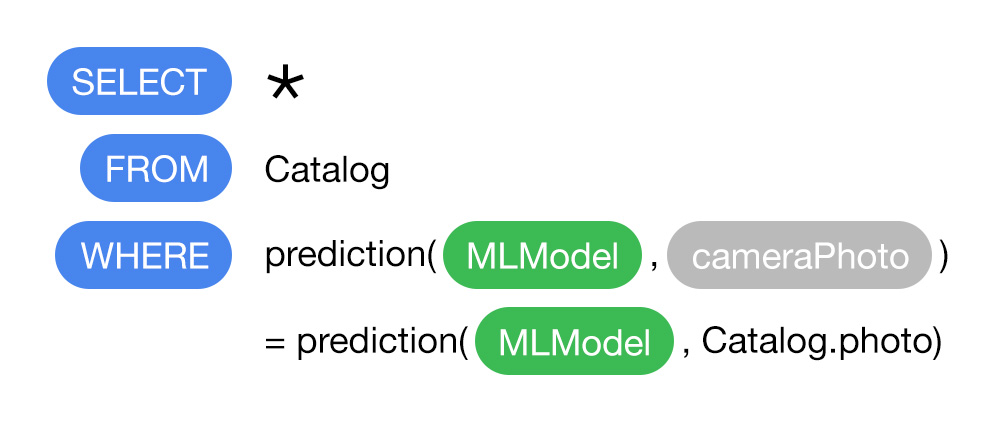
The latter part is what drove a lot of today’s updates, Carter noted. He also believes that the database is the right place to do some machine learning. So with this release, the company is adding predictive queries to its mobile database. This new API allows mobile apps to take pre-trained machine learning models and run predictive queries against the data that is stored locally. This would allow a retailer to create a tool that can use a phone’s camera to figure out what part a customer is looking for.

To support these predictive queries, Couchbase mobile is also getting support for predictive indexes. “Predictive indexes allow you to create an index on prediction, enabling correlation of real-time predictions with application data in milliseconds,” Carter said. In many ways, that’s also the unique value proposition for bringing machine learning into the database. “What you really need to do is you need to utilize the unique values of a database to be able to deliver the answer to those real-time questions within milliseconds,” explained Carter.

The other major new feature in this release is delta synchronization, which allows businesses to push far smaller updates to the databases on their employees mobile devices. That’s because they only have to receive the information that changed instead of a full updated database. Carter says this was a highly requested feature but until now, the company always had to prioritize work on other components of Couchbase.

This is an especially useful feature for the company’s retail customers, a vertical where it has been quite successful. These users need to keep their catalogs up to data and quite a few of them supply their employees with mobile devices to help shoppers. Rumor has it that Apple, too, is a Couchbase user.

The update also includes a few new features that will be more of interest to operators, including advanced stats reporting and enhanced logging support.


InCountry raises $7M to help multinationals store private data in countries of origin

The last few years have seen a rapid expansion of national regulations that, in the name of data protection, govern how and where organizations like healthcare and insurance companies, financial services companies and others store residents’ personal data that is used and collected through their services.

But keeping abreast of and following those rules has proven to be a minefield for companies. Now, a startup is coming out of stealth with a new product to to help.

InCountry, which provides “data residency-as-a-service” to businesses and other organizations, is launching with $7 million in funding and its first product: Profile, which focuses on user profile and registration information in 50 countries on six continents. There will be more products launched covering payment, transaction and health data later in the year, co-founder and CEO Peter Yared said in an interview.

The funding — a seed round — is coming from Caffeinated Capital , Felicis Ventures, Ridge Ventures, Bloomberg Beta, Charles River Ventures, Global Founders Capital.

InCountry is founded and led by Yared, a repeat entrepreneur who most recently co-founded and eventually sold the “micro-app” startup Sapho, which was acquired by Citrix. Other companies he’s sold startups to include VMWare, Sun, and Oracle, and he was also once the CIO of CBS Interactive. 

Yared told me in an interview that he has actually been self-funding, running and quietly accruing customers for InCountry for two years. He decided to raise this seed round — a number of investors in this list are repeat backers of his ventures — to start revving up the engines. (One of those ‘revs’ is an interesting talent hire. Today the company is also announcing Alex Castro as chief product officer. Castro was an early employee working on Amazon Web Services and Mircosoft’s move into CRM, and also worked on autonomous at Uber.)

If you have never heard of the term “data residency-as-a-service”, that might be because it’s something that has been coined by Yared himself to describe the function of his startup.

InCountry is part tech provider, part consultancy.

On the tech side, it provides the technical aspects of providing personal data storage in a specific national border for companies that might otherwise run other aspects of their services from other locations. That includes SDKs that link to a variety of data centers and cloud service providers that allow new countries to be added in under 10 minutes; two types of encryption on the data to make sure that it remains secure; and managed services for its biggest clients. (InCountry is not disclosing any client names right now, except for video-editing company Revl.)

On the consultancy side, it has an in-house team of researchers and partnerships with law firms to continually update its policies and ensure that customers remain compliant with any changes. InCountry says that to provide further assurance to customers, it provides insurance of up to three times the value of a customer’s spend.

InCountry’s aim is twofold: first, to solve the many pain points that a company or other organization has to go through when considering how to comply with data hosting regulations; and second, to make sure that by making it easy, companies actually do what’s required of them.

As Yared describes it, the process for becoming data compliant can be painful, but his startup is applying an economy of scale, since the process is essentially one that everyone will have to follow:

“They have to figure out what the requirements are, find the facility, audit the facility, which includes making sure it’s not owned by the state, make sure the network is properly segregated, develop the right software layer to manage the data, hire program managers, network operations people and more,” he said. And for those handling this themselves, cloud service providers will typically cover a smaller footprint of regions, 17 at most for the biggest. “We take care of all that, and add on more as we need to.”

The problem is that because the process is so painful, many companies often flout the requirements, which isn’t good for its customers, nor for the companies themselves, which run the risk of getting fined.

“It’s universally acknowledged that the way data is stored and handled by most companies and handled is not meeting the average requirements of citizens rights,” Yared said. “That’s why we now have GDPR, and will see more GDPR-like regulations get rolled out.”

One thing that InCountry is not touching is data such as messages between users and other kinds of personal files — data that has been the subject of sometimes very controversial data regulations. Its limit are the pieces of personal information about users — bank details, health information, social security numbers, and so on — that are part and parcel of what we provide to companies in the course of interacting with them online.

“In early outreach, we have had people as for private data storage, but we would be ethically uncomfortable with that,” Yared said. “We want to be in the business of helping people who have regulated data, by storing that in a compliant manner that is more helpful, and more fruitful to users.”

The aim will be to add more services over time covering ever more countries, to keep in line with the growing trend among regulators to put more data residency laws in place.

“We’re witnessing more countries signing in data laws each week, and we’re only going to see those numbers increase,” said Sundeep Peechu, Managing Director at Felicis Ventures, in a statement. “We’re excited to be leading the round and reinvesting in Peter as he launches his seventh company. He recognized the problem early on and started working on a solution nearly two years ago that goes beyond regional data centers and patchwork in-house DIY solutions.”

Tuesday, April 30, 2019

Oculus announces a VR subscription service for enterprises

Oculus is getting serious about monetizing VR for enterprise.

The company has previously sold specific business versions of the headsets, but now they’re adding a pricey annual device-management subscription.

Oculus Go for business starts at $599 (64 GB) and the enterprise Oculus Quest starts at $999 (128 GB). These fees include the first year of enterprise device management and support, which goes for $180 per year per device.

Here’s what that fee gets you:

This includes a dedicated software suite offering device setup and management tools, enterprise-grade service and support, and a new user experience customized for business use cases.

The new Oculus for Business launches in the fall.

Facebook Messenger will get desktop apps, co-watching, emoji status

To win chat, Facebook Messenger must be as accessible as SMS, yet more entertaining than Snapchat. Today, Messenger pushes on both fronts with a series of announcements at Facebook’s F8 conference, including that it will launch Mac and PC desktop apps, a faster and smaller mobile app, simultaneous video co-watching and a revamped Friends tab, where friends can use an emoji to tell you what they’re up to or down for.

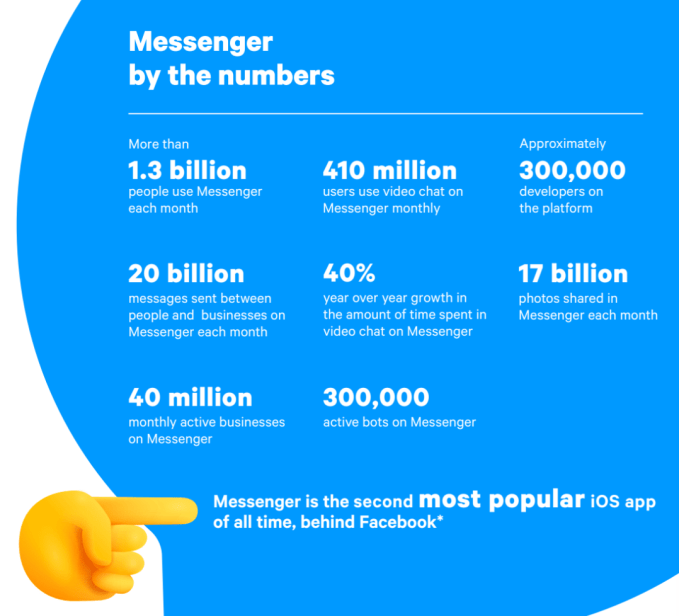
Facebook is also beefing up its tools for the 40 million active businesses and 300,000 businesses on Messenger, up from 200,000 businesses a year ago. Merchants will be able to let users book appointments at salons and masseuses, collect information with new lead generation chatbot templates and provide customer service to verified customers through authenticated m.me links. Facebook hopes this will boost the app beyond the 20 billion messages sent between people and businesses each month, which is up 10X from December 2017.

“We believe you can build practically any utility on top of messaging,” says Facebook’s head of Messenger Stan Chudnovsky. But he stresses that “All of the engineering behind it is has been redone” to make it more reliable, and to comply with CEO Mark Zuckerberg’s directive to unite the backends of Messenger, WhatsApp and Instagram Direct. “Of course, if we didn’t have to do all that, we’d be able to invest more in utilities. But we feel that utilities will be less functional if we don’t do that work. They need to go hand-in-hand together. Utilities will be more powerful, more functional and more desired if built on top of a system that’s interoperable and end-to-end encrypted.”

Here’s a look at the major Messenger announcements and why they’re important:

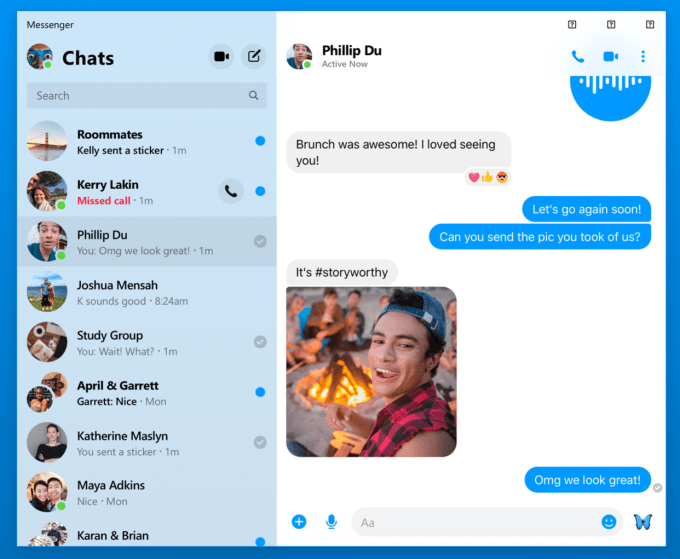
Messenger Desktop – A stripped-down version of Messenger focused on chat, audio and video calls will debut later this year. Chudnovsky says it will remove the need to juggle and resize browser tabs by giving you an always-accessible version of Messenger that can replace some of the unofficial knock-offs. Especially as Messenger focuses more on businesses, giving them a dedicated desktop interface could convince them to invest more in lead generation and customer service through Messenger.

Facebook Messenger’s upcoming desktop app

Project Lightspeed – Messenger is reengineering its app to cut 70 mb off its download size so people with low-storage phones don’t have to delete as many photos to install it. In testing, the app can cold start in merely 1.3 seconds, which Chudnovsky says is just 25 percent of where Messenger and many other apps are today. While Facebook already offers Messenger Light for the developing world, making the main app faster for everyone else could help Messenger swoop in and steal users from the status quo of SMS. The Lightspeed update will roll out later this year.

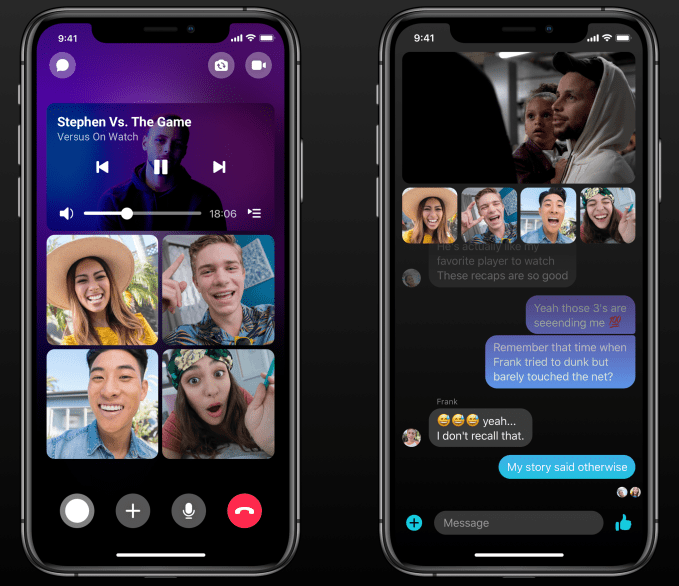
Video Co-Watching – TechCrunch reported in November that Messenger was building a Facebook Watch Party-style experience that would let users pick videos to watch at the same time as a friend, with reaction cams of their faces shown below the video. Now in testing before rolling out later this year, users can pick any Facebook video, invite one or multiple friends and laugh together. Unique capabilities like this could make Messenger more entertaining between utilitarian chat threads and appeal to a younger audience Facebook is at risk of losing.

Watch Videos Together on Messenger

Business Tools – After a rough start to its chatbot program a few years ago, where bots couldn’t figure out users’ open-ended responses, Chudnovsky says the platform is now picking up steam with 300,000 developers on board. One option that’s worked especially well is lead-generation templates, which teach bots to ask people standardized questions to collect contact info or business intent, so Messenger is adding more of those templates with completion reminders and seamless hand-off to a live agent.

To let users interact with appointment-based businesses through a platform they’re already familiar with, Messenger launched a beta program for barbers, dentists and more that will soon open to let any business handle appointment booking through the app. And with new authenticated m.me links, a business can take a logged-in user on their website and pass them to Messenger while still knowing their order history and other info. Getting more businesses hooked on Messenger customer service could be very lucrative down the line.

Appointment booking on Messenger

Close Friends and Emoji Status – Perhaps the most interesting update to Messenger, though, is its upcoming effort to help you make offline plans. Messenger is in the early stages of rebuilding its Friends tab into “Close Friends,” which will host big previews of friends’ Stories, photos shared in your chats, and let people overlay an emoji on their profile pic to show friends what they’re doing. We first reported this “Your Emoji” status update feature was being built a year ago, but it quietly cropped up in the video for Messenger Close Friends. This iteration lets you add an emoji like a home, barbell, low battery or beer mug, plus a short text description, to let friends know you’re back from work, at the gym, might not respond or are interested in getting a drink. These will show up atop the Close Friends tab as well as on location-sharing maps and more once this eventually rolls out.

Messenger’s upcoming Close Friends tab with Your Emoji status

Facebook Messenger is the best poised app to solve the loneliness problem. We often end up by ourselves because we’re not sure which of our friends are free to hang out, and we’re embarrassed to look desperate by constantly reaching out. But with emoji status, Messenger users could quietly signal their intentions without seeming needy. This “what are you doing offline” feature could be a whole social network of its own, as apps like Down To Lunch have tried. But with 1.3 billion users and built-in chat, Messenger has the ubiquity and utility to turn a hope into a hangout.

Docker updates focus on simplifying containerization for developers

Over the last five years, Docker has become synonymous with software containers, but that doesn’t mean every developer understands the technical details of building, managing and deploying them. At DockerCon this week, the company’s customer conference taking place in San Francisco, it announced new tools that have been designed to make it easier for developers, who might not be Docker experts, to work with containers.

As the technology has matured, the company has seen the market broaden, but in order to take advantage of that, it needs to provide a set of tools that make it easier to work with. “We’ve found that customers typically have a small cadre of Docker experts, but there are hundreds, if not thousands, of developers who also want to use Docker. And we reasoned, how can we help them get productive very, very quickly, without them having to become Docker experts,” Scott Johnston, chief product officer at Docker told TechCrunch.

To that end, it announced a Beta of Docker Enterprise 3.0, which includes several key components. For starters, Docker Desktop Enterprise lets IT set up a Docker environment with the kind of security and deployment templates that make sense for each customer. The developers can then pick the templates that make sense for their implementations, while conforming with compliance and governance rules in the company.

“These templates already have IT-approved container images, and have IT-approved configuration settings. And what that means is that IT can provide these templates through these visual tools that allow developers to move fast and choose the ones they want without having go back for approval,” Johnston explained.

The idea is to let the developers concentrate on building applications, and the templates provide all the Docker tooling pre-built and ready to go, so they don’t have to worry about all of that.

Another piece of this is Docker Applications, which allows developers to build complex containerized applications as a single package and deploy them to any infrastructure they wish — on-prem or in the cloud. Five years ago when Docker really got started with containers, they were a simpler idea, often involving just a single one, but as developers broke down those larger applications into microservices, it created a new level of difficulty, especially for operations who had to deploy these increasingly large sets of application containers.

“Operations can now programmatically change the parameters for the containers, depending on the environments without having to go in and change the application. So you can imagine that ability lowers the friction of having to manage all these files in the first place,” he said.

The final piece of that is the orchestration layer and the popular way to handle that today is with Kubernetes. Docker has created its own flavor of Kubernetes, based on the open source tool. Johnston says, as with the other two pieces, the goal here is to take a powerful tool like Kubernetes and reduce the overall complexity associated with running it, while making it fully compatible with a Docker environment.

For that, Docker announced Docker Kubernetes Service (DKS), which has been designed with Docker users in mind including support for Docker Compose, a scripting tool that has been popular with Docker users. While you are free to use any flavor of Kubernetes you wish, Docker is offering DKE as a Docker-friendly version for developers.

All of these components have one thing in common besides being part of Docker Enterprise 3.0. They are trying to reduce the complexity associated with deploying and managing containers and to abstract away the most difficult parts, so that developers can concentrate on developing without having to worry about connecting to the technical underpinnings of building and deploying containers. At the same time, Docker is trying to make it easier for the operations team to manage it all. That is the goal, at least. In the end, DevOps teams will be the final judges on how well Docker has done, once these tools become generally available later this year.

The Docker Enterprise 3.0 Beta will be available later this quarter.

UiPath nabs $568M at a $7B valuation to bring robotic process automation to the front office

Companies are on the hunt for ways to reduce the time and money it costs their employees to perform repetitive tasks, so today a startup that has built a business to capitalize on this is announcing a huge round of funding to double down on the opportunity.

UiPath — a robotic process automation startup originally founded in Romania that uses artificial intelligence and sophisticated scripts to build software to run these tasks — today confirmed that it has closed a Series D round of $568 million at a post-money valuation of $7 billion.

From what we understand, the startup is “close to profitability” and is going to keep growing as a private company. Then, an IPO within the next 12-24 months the “medium term” plan.

“We are at the tipping point. Business leaders everywhere are augmenting their workforces with software robots, rapidly accelerating the digital transformation of their entire business and freeing employees to spend time on more impactful work,” said Daniel Dines, UiPath co-founder and CEO, in a statement. “UiPath is leading this workforce revolution, driven by our core determination to democratize RPA and deliver on our vision of a robot helping every person.”

This latest round of funding is being led by Coatue, with participation from Dragoneer, Wellington, Sands Capital, and funds and accounts advised by T. Rowe Price Associates, Accel, Alphabet’s CapitalG, Sequoia, IVP and Madrona Venture Group.

CFO Marie Myers said in an interview in London that the plan will be to use this funding to expand UiPath’s focus into more front-office and customer-facing areas, such as customer support and sales.

“We want to move into automation into new levels,” she said. “We’re advancing quickly into AI and the cloud, with plans to launch a new AI product in the second half of the year that we believe will demystify it for our users.” The product, she added, will be focused around “drag and drop” architecture and will work both for attended and unattended bots — that is, those that work as assistants to humans, and those that work completely on their own. “Robotics has moved out of the back office and into the front office, and the time is right to move into intelligent automation.”

Today’s news confirms Kate’s report from last month noting that the round was in progress: in the end, the amount UiPath raised was higher than the target amount we’d heard ($400 million), with the valuation on the more “conservative” side (we’d said the valuation would be higher than $7 billion).

“Conservative” is a relative term here. The company has been on a funding tear in the last year, raising $418 million ($153 million at Series A and $265 million at Series B) in the space of 12 months, and seeing its valuation go from a modest $110 million in April 2017 to $7 billion today, just two years later.

Up to now, UiPath has focused on internal and back-office tasks in areas like accounting, human resources paperwork, and claims processing — a booming business that has seen UiPath expand its annual run rate to more than $200 million (versus $150 million six months ago) and its customer base to more than 400,000 people.

Customers today include American Fidelity, BankUnited, CWT (formerly known as Carlson Wagonlit Travel), Duracell, Google, Japan Exchange Group (JPX), LogMeIn, McDonalds, NHS Shared Business Services, Nippon Life Insurance Company, NTT Communications, Orange, Ricoh Company, Ltd., Rogers Communications, Shinsei Bank, Quest Diagnostics, Uber, the US Navy, Voya Financial, Virgin Media, and World Fuel Services.

Moving into more front-office tasks is an ambitious but not surprising leap for UiPath: looking at that customer list, it’s notable that many of these organizations have customer-facing operations, often with their own sets of repetitive processes that are ripe for improving by tapping into the many facets of AI — from computer vision to natural language processing and voice recognition, through to machine learning — alongside other technology.

It also begs the question of what UiPath might look to tackle next. Having customer-facing tools and services is one short leap from building consumer services, an area where the likes of Amazon, Google, Apple and Microsoft are all pushing hard with devices and personal assistant services. (That would indeed open up the competitive landscape quite a lot for UiPath, beyond the list of RPA companies like AutomationAnywhere, Kofax and Blue Prism who are its competitors today.)

Robotics has been given a somewhat bad rap in the world of work: critics worry that they are “taking over all the jobs“, removing humans and their own need to be industrious from the equation; and in the worst-case scenarios, the work of a robot lacks the nuance and sophsitication you get from the human touch.

UiPath and the bigger area of RPA are interesting in this regard: the aim (the stated aim, at least) isn’t to replace people, but to take tasks out of their hands to make it easier for them to focus on the non-repetitive work that “robots” — and in the case of UiPath, software scripts and robots — cannot do.

Indeed, that “future of work” angle is precisely what has attracted investors.

“UiPath is enabling the critical capabilities necessary to advance how companies perform and how employees better spend their time,” said Greg Dunham, vice president at T. Rowe Price Associates, Inc., in a statement. “The industry has achieved rapid growth in such a short time, with UiPath at the head of it, largely due to the fact that RPA is becoming recognized as the paradigm shift needed to drive digital transformation through virtually every single industry in the world.”

As we’ve written before, the company has has been a big hit with investors because of the rapid traction it has seen with enterprise customers.

There is an interesting side story to the funding that speaks to that traction: Myers, the CFO, came to UiPath by way of one of those engagements: she had been a senior finance executive with HP tasked with figuring out how to make some of its accounting more efficient. She issued an RFP for the work, and the only company she thought really addressed the task with a truly tech-first solution, at a very competitive price, was an unlikely startup out of Romania, which turned out to be UiPath. She became one of the company’s first customers, and eventually Dines offered her a job to help build his company to the next level, which she leaped to take.

“UiPath is improving business performance, efficiency and operation in a way we’ve never seen before,” said Philippe Laffont, founder of Coatue Management, in a statement. “The Company’s rapid growth over the last two years is a testament to the fact that UiPath is transforming how companies manage their resources. RPA presents an enormous opportunity for companies around the world who are embracing artificial intelligence, driving a new era of productivity, efficiency and workplace satisfaction.”