Monday, April 29, 2019

With Kata Containers and Zuul, OpenStack graduates its first infrastructure projects

Over the course of the last year and a half, the OpenStack Foundation made the switch from purely focusing on the core OpenStack project to opening itself up to other infrastructure-related projects as well. The first two of these projects, Kata Containers and the Zuul project gating system, have now exited their pilot phase and have become the first top-level Open Infrastructure Projects at the OpenStack Foundation.

The Foundation made the announcement at its first Open Infrastructure Summit (previously known as the OpenStack Summit) in Denver today after the organization’s board voted to graduate them ahead of this week’s conference. “It’s an awesome milestone for the projects themselves,” OpenStack Foundation executive direction Jonathan Bryce told me. “It’s a validation of the fact that in the last 18 months, they have created sustainable and productive communities.”

It’s also a milestone for the OpenStack Foundation itself, though, which is still in the process of reinventing itself in many ways. It can now point at two successful projects that are under its stewardship, which will surely help it as it goes out an tries to attract others who are looking to bring their open-source projects under the aegis of a foundation.
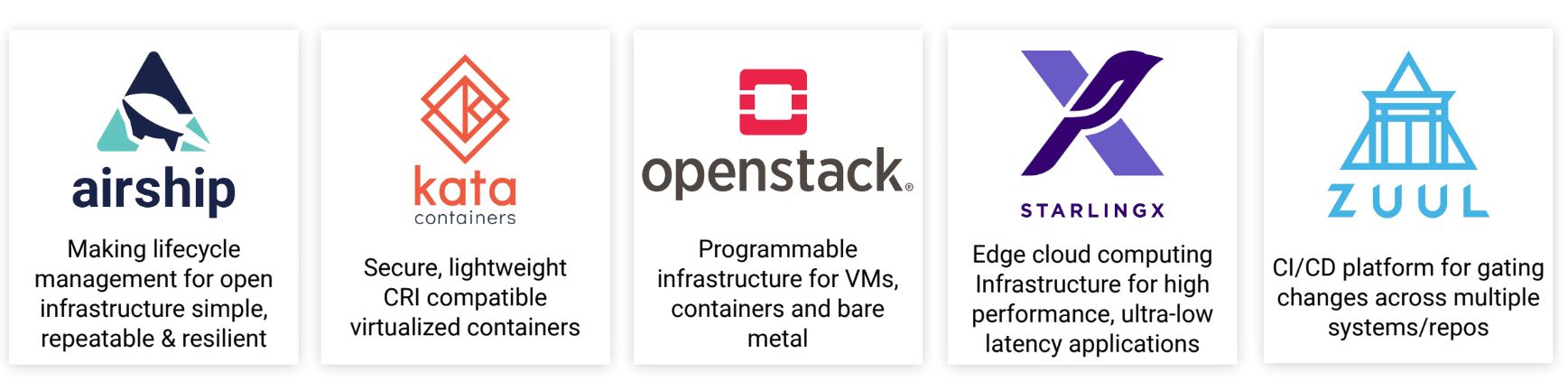
In addition to graduating these first two projects, Airship — a collection of open-source tools for provisioning private clouds that is currently a pilot project — hit version 1.0 today. “Airship originated within AT&T,” Bryce said. “They built it from their need to bring a bunch of open-source tools together to deliver on their use case. And that’s why, from the beginning, it’s been really well aligned with what we would love to see more of in the open source world and why we’ve been super excited to be able to support their efforts there.”

With Airship, developers use YAML documents to describe what the final environment should like like and the result of that is a production-ready Kubernetes cluster that was deployed by OpenStack’s Helm tool – though without any other dependencies on OpenStack.

AT&T’s assistant vice president, Network Cloud Software Engineering, Ryan van
Wyk, told me that a lot of enterprises want to use certain open-source components, but that the interplay between them is often difficult and that while it’s relatively easy to manage the lifecycle of a single tool, it’s hard to do so when you bring in multiple open-source tools, all with their own lifecycles. “What we found over the last five years working in this space is that you can go and get all the different open-source solutions that you need,” he said. “But then the operator has to invest a lot of engineering time and build extensions and wrappers and perhaps some orchestration to manage the lifecycle of the various pieces of software required to deliver the infrastructure.”

It’s worth noting that nothing about Airship is specific to the telco world, though it’s no secret that OpenStack is quite popular in the telco world and unsurprisingly, the Foundation is using this week’s event to highlight the OpenStack project’s role in the upcoming 5G rollouts of various carriers.

In addition, the event will also showcase OpenStack’s bare metal capabilities, an area the project has also focused on in recent releases. Indeed, the Foundation today announced that its bare metal tools now manage over a million cores of compute. To codify these efforts, the Foundation also today launched the OpenStack Ironic Bare Metal program, which brings together some of the project’s biggest users like Verizon Media (home of TechCrunch, though we don’t run on the Verizon cloud), 99Cloud, China Mobile, China Telecom, China Unicom, Mirantis, OVH, Red Hat, SUSE, Vexxhost and ZTE.

Tray.io hauls in $37 million Series B to keep expanding enterprise automation tool

Tray.io, the startup that wants to put automated workflows within reach of line of business users, announced a $37 million Series B investment today.

Spark Capital led the round with help from Meritech Capital, along with existing investors GGV Capital, True Ventures and Mosaic Ventures. Under the terms of the deal Spark’s Alex Clayton will be joining the Tray’s board of directors. The company has now raised over $59 million.

Rich Waldron, CEO at Tray, says the company looked around at the automation space and saw tools designed for engineers and IT pros and wanted to build something for less technical business users.

“We set about building a visual platform that would enable folks to essentially become programmers without needing to have an engineering background, and enabling them to be able to build out automation for their day-to-day role.”

He added, “As a result, we now have a service that can be used in departments across an organization, including IT, whereby they can build extremely powerful and flexible workflows that gather data from all these disparate sources, and carry out automation as per their desire.”

Alex Clayton from lead investor Spark Capital sees Tray filling in a big need in the automation space in a spot between high end tools like Mulesoft, which Salesforce bought last year for $6.5 billion, and simpler tools like Zapier. The problem, he says, is that there’s a huge shortage of time and resources to manage and really integrate all these different SaaS applications companies are using today to work together.

“So you really need something like Tray because the problem with the current Status Quo [particularly] in marketing sales operations, is that they don’t have the time or the resources to staff engineering for building integrations on disparate or bespoke applications or workflows,” he said.

Tray is a seven year old company, but started slowly taking the first 4 years to build out the product. They got $14 million Series A 12 months ago and have been taking off ever since. The company’s annual recurring revenue (ARR) is growing over 450 percent year over year with customers growing by 400 percent, according to data from the company. It already has over 200 customers including Lyft, Intercom, IBM and SAP.

The company’s R&D operation is in London, with headquarters in San Francisco. It currently has 85 employees, but expects to have 100 by the end of the quarter as it begins to put the investment to work.

Friday, April 26, 2019

Slack files to go public, reports $138.9M in losses on revenue of $400.6M

Slack has filed to go public via a direct listing. Similar to what Spotify did last year, this means that the company won’t have a traditional IPO, and will instead allow existing shareholders to sell their stock to investors.

The company’s S-1 filing says it plans to make $100 million worth of shares available, but that’s probably a placeholder figure.

The S-1 offers data about the company’s financial performance, reporting a net loss of $138.9 million and revenue of $400.6 million in the fiscal year ending January 31, 2019. That’s compared to a loss of $140.1 million on revenue of $220.5 million for the year before.

The company attributes these losses to its decision “to invest in growing our business to capitalize on our market opportunity,” and notes that they’re shrinking as a percentage of revenue.

Slack also says that in the three months ending on January 31, it had more than 10 million daily active users across more than 600,000 organizations — 88,000 on the paid plan and 550,000 on the free plan.

In the filing, the company says the Slack team created the product to meet its own collaboration needs.

“Since our public launch in 2014, it has become apparent that organizations worldwide have similar needs, and are now finding the solution with Slack,” it says. “Our growth is largely due to word-of-mouth recommendations. Slack usage inside organizations of all kinds is typically initially driven bottoms-up, by end users. Despite this, we (and the rest of the world) still have a hard time explaining Slack. It’s been called an operating system for teams, a hub for collaboration, a connective tissue across the organization, and much else. Fundamentally, it is a new layer of the business technology stack in a category that is still being defined.”

The company suggests that the total market opportunity for Slack and other makers of workplace collaboration software is $28 billion, and it plans to grow through strategies like expanding its footprint within organizations already using Slack, investing in more enterprise features, expanding internationally and growing the developer ecosystem.

The risk factors mentioned in the filing sound pretty boilerplate and/or similar to other Internet companies going public, like the aforementioned net losses and the fact that its current growth rate might not be sustainable, as well as new compliance risks under Europe’s GDPR.

Slack has previously raised a total of $1.2 billion in funding, according to Crunchbase, from investors including Accel, Andreessen Horowitz, Social Capital, SoftBank, Google Ventures and Kleiner Perkins.

Thursday, April 25, 2019

AWS expands cloud infrastructure offerings with new AMD EPYC-powered T3a instances

Amazon is always looking for ways to increase the options it offers developers in AWS, and to that end, today it announced a bunch of new AMD EPYC-powered T3a instances. These were originally announced at the end of last year at re:Invent, AWS’s annual customer conference.

Today’s announcement is about making these chips generally available. They have been designed for a specific type of burstable workload, where you might not always need a sustained amount of compute power.

“These instances deliver burstable, cost-effective performance and are a great fit for workloads that do not need high sustained compute power but experience temporary spikes in usage. You get a generous and assured baseline amount of processing power and the ability to transparently scale up to full core performance when you need more processing power, for as long as necessary,” AWS’s Jeff Barr wrote in a blog post.

These instances are build on the AWS Nitro System, Amazon’s custom networking interface hardware that the company has been working on for the last several years. The primary components of this system include the Nitro Card I/O Acceleration, Nitro Security Chip and the Nitro Hypervisor.

Today’s release comes on top of the announcement last year that the company would be releasing EC2 instances powered by Arm-based AWS Graviton Processors, another option for developers, who are looking for a solution for scale-out workloads.

It also comes on the heels of last month’s announcement that it was releasing EC2 M5 and R5 instances, which use lower-cost AMD chips. These are also built on top of the Nitro System.

The EPCY processors are available starting today in seven sizes in your choice of spot instances, reserved instances or on-demand, as needed. They are available in US East in northern Virginia, US West in Oregon, Europe in ireland, US East in Ohio and Asia-Pacific in Singapore.

SalesLoft nabs $70M at $500M valuation for its sales engagement platform

Artificial intelligence and other tech for automating some of the more repetitive aspects of human jobs continues to be a growing category of software, and today a company that builds tools to address this need for salespeople has raised a tidy sum to grow its business.

SalesLoft, an Atlanta-based startup that has built a platform for salespeople to help them engage with their clients — providing communications tools, supporting data, and finally analytics to ‘coach’ salespeople to improve their processes — has raised $70 million in a Series D round of funding led by Insight Venture Partners with participation from HarbourVest.

Kyle Porter, SalesLoft’s co-founder and CEO, would not disclose the amount of funding in an interview but he did confirm that it is double its valuation from the previous round, a $50 million Series C that included LinkedIn among the investors (more on that below). That round was just over a year ago and would have valued the firm at $250 million. That would put SalesLoft’s current valuation at about $500 million.

While there are a number of CRM and sales tools out in the market today, Porter believes that many of the big ones might better be described as “dumb databases or repositories” of information rather than natively aimed at helping source and utilise data more effectively.

“They are not focused on improving how to connect buyers to sales teams in sincere ways,” he said. “And anytime a company like Salesforce has moved into tangential areas like these, they haven’t built from the ground up, but through acquisitions. It’s just hard to move giant aircraft carriers.”

SalesLoft is not the only one that has spotted this opportunity, of course. There are dozens of others that are either competing on single or all aspects of the same services that SalesLoft provides, including the likes of Clari, Chorus.ai, Gong, Conversica, Afiniti and not least Outreach — which is seen as a direct competitor on sales engagement and itself raised $114 million on a $1.1 billion valuation earlier this month.

One of the notable distinctions for SalesLoft is that one of its strategic investors is LinkedIn, which participated in its Series C. Before Microsoft acquired it, LinkedIn was seen as a potential competitor to SalesForce, and many thought that Microsoft’s acquisition was made squarely to help it compete against the CRM giant.

These days, Porter said that his company and LinkedIn have a tight integration by way of LinkedIn’s Sales Navigator product, which SalesLoft users can access and utilise directly within SalesLoft, and they have a hotline to be apprised of and help shape LinkedIn’s API developments. SalesLoft is also increasingly building links into Microsoft Dynamics, the company’s CRM business.

“We are seeing the highest usage in our LinkedIn integration among all the other integrations we provide,” Porter told me. “Our customers find that it’s the third most important behind email and phone calls.” Email, for all its cons, remains the first.

The fact that this is a crowded area of the market does speak to the opportunity and need for something effective, however, and the fact that SalesLoft has grown revenues 100 percent in each of the last two years, according to Porter, makes it a particularly attractive horse to bet on.

“So many software companies build a product to meet a market need and then focus purely on selling. SalesLoft is different. This team is continually innovating, pushing the boundaries, and changing the face of sales,” said Jeff Horing, co-founder and MD of Insight Venture Partners, in a statement. “This is one reason the company’s customers are so devoted to them. We are privileged to partner with this innovative company on their mission to improve selling experiences all over the world.”

Going forward, Porter said that in addition to expanding its footprint globally — recent openings include a new office in London — the company is going to go big on more AI and “intelligence” tools. The company already offers something it calls its “coaching network” which is not human but AI-based and analyses calls as they happen to provide pointers and feedback after the fact (similar to others like Gong and Chorus, I should note).

“We want to give people a better way to deliver an authentic but ultimately human way to sell,” he said.

Wednesday, April 24, 2019

Slack to extend collaboration to folks who don’t want to give up email

As Slack gathered with its growing customer base this week at the Frontiers Conference in San Francisco, it announced several enhancements to the product including extending collaboration to folks who want to stick with email instead of hanging with their co-workers in Slack.

Some habits are tough to break and using email as your file sharing and collaboration tool is one of them. Email is great for certain types of communications, but it was never really designed to be a full-fledged communications tool. While a tool like Slack might not ever fully replace email, it is going after it hard.

But Andy Pflaum, director of project management at Slack says, rather than fight those folks, Slack decided to make it easier to include them with a new email and calendar bridge that enables team members who might not have made the leap to Slack to continue to be kept in the loop.

Instead of opening Slack and seeing the thread, the message will come to these stragglers in their trusty old email inbox, just the way they like it. Earlier this month the company announced tighter integration between Slack and Outlook calendar and email (building on a similar integration with GMail and Google Calendar) where emails and calendar entries can be shared inside Slack. Pflaum says that the company is trying to take that email and calendar bridge idea one step further.

The non-Slack users would get an email instead with the Slack thread. It bundles together multiple responses to a thread in which the person has been engaging in an email, so the recipient isn’t getting an email for every response, according to Pflaum.

The person can respond by clicking a Slack button in the email and having Slack open, or they can simply reply to the email and the response will go to Slack automatically. If they choose the former, it might be a sneaky way to get them used to using Slack instead of email, but Pflaum says that it is not necessarily the intent.

Slack is simply responding to a request by customers to have this ability because apparently there are a percentage of people who would prefer to continue working inside email. The ability to open Slack to reply will be available soon. The ability to reply to Slack with the Reply button will be available later this year.

Microsoft beats expectations with $30.6B in revenue as Azure’s growth continues

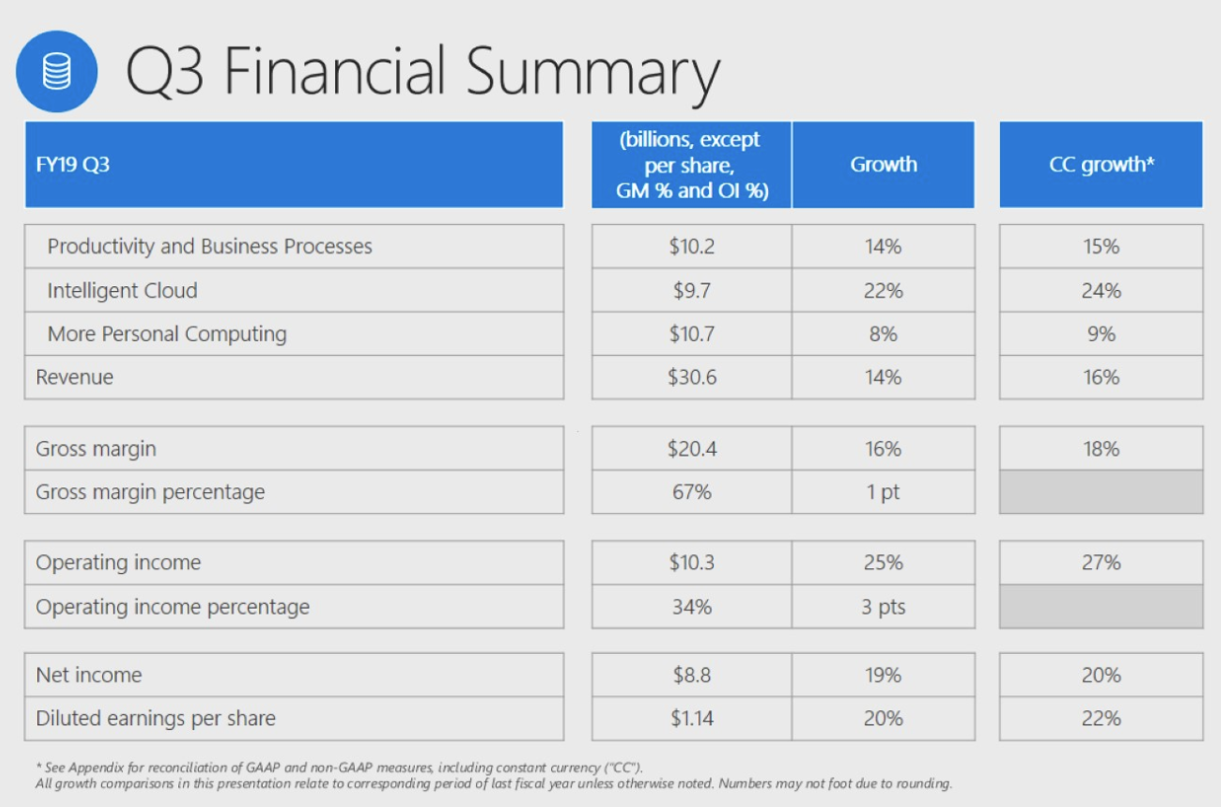
Microsoft reported its quarterly earnings for Q3 2019 today. Overall, Wall Street expected earnings of about $1 per share and revenue of $29.84 billion. The company handily beat this with revenue of $30.6 billion (up 14 percent from the year-ago quarter) and earnings per share of $1.14.

With Microsoft focusing heavily on its cloud business, with both Azure and its other cloud-based services, it’s no surprise that this is also what Wall Street really cares about. The expectation here, according to some analysts, was that the company’s overall commercial cloud business would hit a run rate of about $38.5 billion. Those analysts we’re off by only a tiny bit. Microsoft today reported that its commercial cloud run-rate hot $38.4 billion.

And indeed, Microsoft Azure had a pretty good quarter, with revenue growing 73 percent. That’s a bit lower than last quarter’s results, but only by a fraction, and shows that there is plenty of growth left for Microsoft’s cloud infrastructure business.

Azure’s growth slowed somewhat in recent quarters. In some ways, that’s to be expected, though. Microsoft’s cloud is now a massive business and posting 100 percent growth when you have a run rate of almost $40 billion becomes a bit harder.

“Demand for our cloud offerings drove commercial cloud revenue to $9.6 billion this quarter, up 41% year-over-year,” said Amy Hood, executive vice president and chief financial officer of Microsoft. “We continue to drive growth in revenue and operating income with consistent execution from our sales teams and partners and targeted strategic investments.”

The company’s ‘intelligent cloud’ segment, which includes Azure and other cloud- and server-based products, reported revenue of $9.7 billion, up 22 percent from the year-ago quarter.

Microsoft’s productivity applications also fared well, with total revenue up by 14 percent to $10.2 billion. Here, revenue from LinkedIn also increased by 27 percent and the company highlighted that LinkedIn sessions also increased 24 percent.

Other highlights of the report include an increase in Surface revenue of 21 percent, which was expected given the number of new devices the company released in recent quarters.

“Leading organizations of every size in every industry trust the Microsoft cloud. We are accelerating our innovation across the cloud and edge so our customers can build the digital capability increasingly required to compete and grow,” said Satya Nadella, CEO of Microsoft.

For more financial details, you can find the full report here.