Monday, May 7, 2018

Microsoft and DJI team up to bring smarter drones to the enterprise

At the Microsoft Build developer conference today, Microsoft and Chinese drone manufacturer DJI announced a new partnership that aims to bring more of Microsoft’s machine learning smarts to commercial drones. Given Microsoft’s current focus on bringing intelligence to the edge, this is almost a logical partnership, given that drones are essentially semi-autonomous edge computing devices.

DJI also today announced that Azure is now its preferred cloud computing partner and that it will use the platform to analyze video data, for example. The two companies also plan to offer new commercial drone solutions using Azure IoT Edge and related AI technologies for verticals like agriculture, construction and public safety. Indeed, the companies are already working together on Microsoft’s FarmBeats solution, an AI and IoT platform for farmers.

As part of this partnership, DJI is launching a software development kit (SDK) for Windows that will allow Windows developers to build native apps to control DJI drones. Using the SDK, developers can also integrate third-party tools for managing payloads or accessing sensors and robotics components on their drones. DJI already offers a Windows-based ground station.

“DJI is excited to form this unique partnership with Microsoft to bring the power of DJI aerial platforms to the Microsoft developer ecosystem,” said Roger Luo, DJI president, in today’s announcement. “Using our new SDK, Windows developers will soon be able to employ drones, AI and machine learning technologies to create intelligent flying robots that will save businesses time and money and help make drone technology a mainstay in the workplace.”

Interestingly, Microsoft also stresses that this partnership gives DJI access to its Azure IP Advantage program. “For Microsoft, the partnership is an example of the important role IP plays in ensuring a healthy and vibrant technology ecosystem and builds upon existing partnerships in emerging sectors such as connected cars and personal wearables,” the company notes in today’s announcement.

Microsoft brings more AI smarts to the edge

At its Build developer conference this week, Microsoft is putting a lot of emphasis on artificial intelligence and edge computing. To a large degree, that means bringing many of the existing Azure services to machines that sit at the edge, no matter whether that’s a large industrial machine in a warehouse or a remote oil-drilling platform. The service that brings all of this together is Azure IoT Edge, which is getting quite a few updates today. IoT Edge is a collection of tools that brings AI, Azure services and custom apps to IoT devices.

As Microsoft announced today, Azure IoT Edge, which sits on top of Microsoft’s IoT Hub service, is now getting support for Microsoft’s Cognitive Services APIs, for example, as well as support for Event Grid and Kubernetes containers. In addition, Microsoft is also open sourcing the Azure IoT Edge runtime, which will allow developers to customize their edge deployments as needed.

The highlight here is support for Cognitive Services for edge deployments. Right now, this is a bit of a limited service as it actually only supports the Custom Vision service, but over time, the company plans to bring other Cognitive Services to the edge as well. The appeal of this service is pretty obvious, too, as it will allow industrial equipment or even drones to use these machine learning models without internet connectivity so they can take action even when they are offline.

As far as AI goes, Microsoft also today announced that it will bring its new Brainwave deep neural network acceleration platform for real-time AI to the edge.

The company has also teamed up with Qualcomm to launch an AI developer kit for on-device inferencing on the edge. The focus of the first version of this kit will be on camera-based solutions, which doesn’t come as a major surprise given that Qualcomm recently launched its own vision intelligence platform.

IoT Edge is also getting a number of other updates that don’t directly involve machine learning. Kubernetes support is an obvious one and a smart addition, given that it will allow developers to build Kubernetes clusters that can span both the edge and a more centralized cloud.

The appeal of running Event Grid, Microsoft’s event routing service, at the edge is also pretty obvious, given that it’ll allow developers to connect services with far lower latency than if all the data had to run through a remote data center.

Other IoT Edge updates include the planned launch of a marketplace that will allow Microsoft partners and developers to share and monetize their edge modules, as well as a new certification program for hardware manufacturers to ensure that their devices are compatible with Microsoft’s platform. IoT Edge, as well as Windows 10 IoT and Azure Machine Learning, will also soon support hardware-accelerated model evaluation with DirextX 12 GPU, which is available in virtually every modern Windows PC.

As Kubernetes grows, a startup ecosystem develops in its wake

Kubernetes, the open source container orchestration tool, came out of Google several years ago and has gained traction amazingly fast. With each step in its growth, it has created opportunities for companies to develop businesses on top of the open source project.

The beauty of open source is that when it works, you build a base platform and an economic ecosystem follows in its wake. That’s because a project like Kubernetes (or any successful open source offering) generates new requirements as a natural extension of the growth and development of a project.

Those requirements represent opportunities for new projects, of course, but also for startups looking at building companies adjacent that open source community. Before that can happen however, a couple of key pieces have to fall into place.

Ingredients for success

For starters you need the big corporates to get behind it. In the case of Kuberentes, in a 6 week period last year in quick succession between July and the beginning of September, we saw some of the best known enterprise technology companies including AWSOracleMicrosoftVMware and Pivotal all join the Cloud Native Computing Foundation (CNCF), the professional organization behind the open source project. This was a signal that Kubernetes was becoming a standard of sorts for container orchestration.

Surely these big companies would have preferred (and tried) to control the orchestration layer themselves, but they soon found that their customers preferred to use Kubernetes and they had little choice, but to follow the clear trend that was developing around the project.

Photo: Georgijevic on Getty Images

The second piece that has to come together for an open source community to flourish is that a significant group of developers have to accept it and start building stuff on top of the platform — and Kubernetes got that too. Consider that according to CNCF, a total of 400 projects have been developed on the platform by 771 developers contributing over 19,000 commits since the launch of Kubernetes 1.0 in 2015. Since last August, the last date for which the CNCF has numbers, developer contributions had increased by 385 percent. That’s a ton of momentum.

Cue the investors

When you have those two ingredients in place — developers and large vendors — you can begin to gain velocity. As more companies and more developers come, the community continues to grow, and that’s what we’ve been seeing with Kubernetes.

As that happens, it typically doesn’t take long for investors to take notice, and according to CNCF, there has been over $4 billion in investments so far in cloud native companies — this from a project that didn’t even exist that long ago.

Photo: Fitria Ramli / EyeEm on Getty Images.

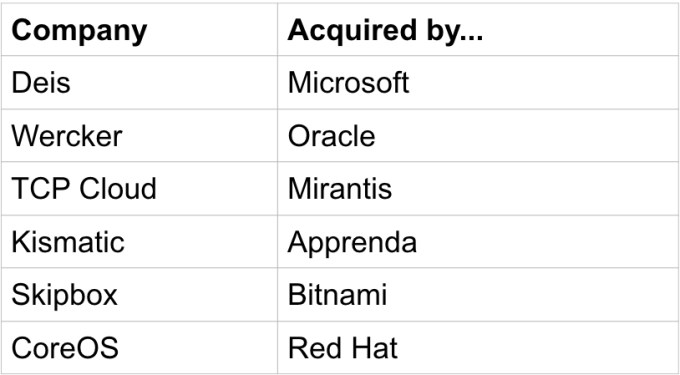
That investment has taken the form of venture capital funding startups trying to build something on top of Kubernetes, and we’ve seen some big raises. Earlier this month, Hasura raised a $1.6M seed round for a packaged version Kubernetes designed specially to meet the needs of developers. Just last week, Upbound, a new startup from Seattle got $9 million in its Series A round to help manage multi-cluster and multi-cloud environments in a standard (cloud-native) way. A little further up the maturity curve, Heptio has raised over $33 million with its most recent round being a $25 million Series B last September. Finally, there is CoreOS, which raised almost $50 million before being sold to Red Hat for $250 million in January.

CoreOS wasn’t alone by any means as we’ve seen other exits coming over the last year or two with organizations scooping up cloud native startups. In particular, when you see the largest organizations like Microsoft, Oracle and Red Hat buying relatively young startups, they are often looking for talent, customers and products to get up to speed more quickly in a growing technology area like Kubernetes.
Growing an economic ecosystem

Kubernetes has grown and developed into an economic powerhouse in short period of time as dozens of side projects have developed around it, creating even more opportunity for companies of all sizes to build products and services to meet an ever-growing set of needs in a virtuous cycle of investment, innovation and economic activity.
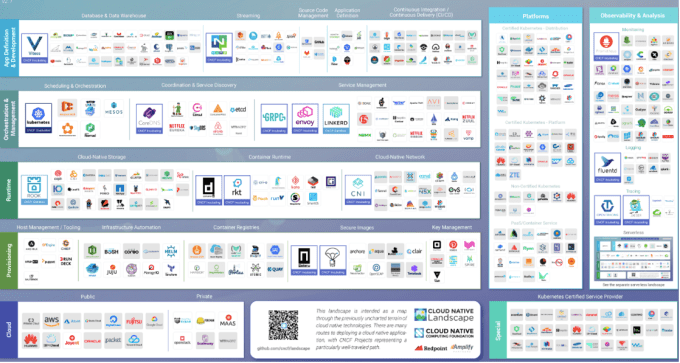
Cloud Native Computing Foundation projects. Photo: Cloud Native Computing Foundation

If this project continues to grow, chances are it will gain even more investment as companies continue to flow toward containers and Kubernetes, and even more startups develop to help create products to meet new needs as a result.


Watch the Microsoft Build 2018 keynote live right here

Microsoft is holding its annual Build developer conference this week and the company is kicking off the event with its inaugural keynote this morning. You can watch the live stream right here.

The keynote is scheduled to start at 8:30 am on the West Coast, 11:30 am on the East Coast, 4:30 pm in London and 5:30 pm in Paris.

This is a developer conference, so you shouldn’t expect new hardware devices. Build is usually focused on all things Windows 10, Azure and beyond. It’s a great way to see where Microsoft is heading. We have a team on the ground, so you can follow all of our coverage on TechCrunch.

Mesosphere hauls in $125 M Series D investment

Mesosphere, a company that created an operating system of sorts for the modern datacenter, announced today that it has raised $125 million for their Series D round. Today’s investment brings total funding since it formed in 2013 to almost $250 million.

The round was led by T. Rowe Price Associates and Koch Disruptive Technologies (KDT). New investors ZWC Ventures, Qatar Investment Authority (QIA) and Disruptive Technology Advisers (DTA) also participated along with existing investors Andreessen Horowitz, Two Sigma Ventures, Khosla Ventures and Hewlett Packard Enterprise.

The funding comes at a time when the company has tripled its revenue and wants to take that momentum and expand more into international markets. They currently have 300 employees, 125 customers and are on a $50 million revenue run rate, according to information supplied by Mesosphere.

CEO Florian Leibert says his company decided to take on this money at this point because it sees a market opportunity and needed the funds to expand. “With this latest round, we’ll be able to ramp up R&D and hone our product roadmap toward repeatable, proven solutions around data engineering and data science,” Leibert told TechCrunch.

He wants to take those products to more international markets including Europe, China and the Middle East, while increasing their channel presence, especially with international and regional systems integrators, who can help pave the way into these markets.

Mesosphere’s core technology, called DC/OS, provides a way to manage datacenter resources, whether private or in the public cloud, much more efficiently than traditional tools by treating the entire datacenter as a single pool of resources, Tobias Knaup, Mesosphere CTO explained. This allows an operations team to see multiple locations, zones and regions from a single interface, he said.

Mesosphere has taken on a mix of traditional venture capitalists, international funding authorities and strategic corporate backers, but the presence of T Rowe Price and the size of the round could be a signal that the company intends to go public at some point. Leibert wasn’t willing to give anything away, however.

“We are focused on growth and building a self-sustaining company. We certainly haven’t ruled out a public event in the future, but I can’t speak to any specific plans at this time.” In other words, the standard CEO answer to such a question.

The companies last round was in March 2016 for $73.5 million.

Friday, May 4, 2018

Google Kubeflow, machine learning for Kubernetes, begins to take shape

Ever since Google created Kubernetes as an open source container orchestration tool, it has seen it blossom in ways it might never have imagined. As the project gains in popularity, we are seeing many adjunct programs develop. Today, Google announced the release of version 0.1 of the Kubeflow open source tool, which is designed to bring machine learning to Kubernetes containers.

While Google has long since moved Kubernetes into the Cloud Native Computing Foundation, it continues to be actively involved, and Kubeflow is one manifestation of that. The project was only first announced at the end of last year at Kubecon in Austin, but it is beginning to gain some momentum.

David Aronchick, who runs Kubeflow for Google, led the Kubernetes team for 2.5 years before moving to Kubeflow. He says the idea behind the project is to enable data scientists to take advantage of running machine learning jobs on Kubernetes clusters. Kubeflow lets machine learning teams take existing jobs and simply attach them to a cluster without a lot of adapting.

With today’s announcement, the project begins to move ahead, and according to a blog post announcing the milestone, brings a new level of stability, while adding a slew of new features that the community has been requesting. These include Jupyter Hub for collaborative and interactive training on machine learning jobs and Tensorflow training and hosting support, among other elements.

Aronchick emphasizes that as an open source project you can bring whatever tools you like, and you are not limited to Tensorflow, despite the fact that this early version release does include support for Google’s machine learning tools. You can expect additional tool support as the project develops further.

In just over 4 months since the original announcement, the community has grown quickly with over 70 contributors, over 20 contributing organizations along with over 700 commits in 15 repositories. You can expect the next version, 0.2, sometime this summer.

Thursday, May 3, 2018

Datadog provides visibility into Kubernetes apps with new container map

As companies turn increasingly to containerization, it creates challenges in terms of monitoring each individual container and the impact on the underlying application. This is particularly difficult because of the ephemeral nature of containers, which can exist for a very short time. Datadog introduced a container map product today that could help by bringing visualization to bear on the problem.

“With his announcement, what we are doing is introducing a container map to show you all of the containers across your system,” Ilan Rabinovitch, VP of Product Management at Datadog told TechCrunch. This could enable customers to see every container at any given time, organize them into groups based on tags, then drill-down to see what’s happening within each one.

The company makes use of tags and metadata to identify the different parts of the containers and their relationship to one another and the underlying infrastructure. The tool monitors containers much like any other entity in Datadog.

“Just as the host map does with individual instances, the container map enables you to easily group, filter, and inspect your containers using metadata such as services, availability zones, roles, partitions, or any other dimension you like,” the company wrote in a blog post introducing the new feature.

While Datadog won’t help a company directly remediate a problem as it avoids having write access to a company’s systems, the customer can use Web hooks or a serverless trigger like an Amazon Lambda function to invoke some sort of action should certain conditions be met that could compromise or break the application.

[gallery ids="1633132,1633133,1633134"]

The company is simply acting as a third party watching to make sure the containers all behave properly. “We trust Kubernetes to do what it should do. But when something breaks, you need to be able to understand what happened, and Kubernetes is not designed to do this,” Rabinovitch said. The new map features provides that missing visibility into the container system and lets users drill down inside individual containers to pinpoint the source of a problem.