Tuesday, April 24, 2018

Tableau gets new pricing plans and a data preparation tool

Data analytics platform Tableau today announced the launch of both a new data preparation product and a new subscription pricing plan.

Currently, Tableau offers desktop plans for users who want to analyze their data locally, a server plan for businesses that want to deploy the service on-premises or on a cloud platform, and a fully hosted online plan. Prices for these range from $35 to $70 per user and month. The new pricing plans don’t focus so much on where the data is analyzed but on the analyst’s role. The new Creator, Explorer and Viewer plans are tailored toward the different user experiences. They all include access to the new Tableau Prep data preparation tool, Tableau Desktop and new web authoring capabilities — and they are available both on premises or in the cloud.

Existing users can switch their server or desktop subscriptions to the new release today and then assign each user either a creator, explorer or viewer role. As the name indicates, the new viewer role is meant for users who mostly consume dashboards and visualizations, but don’t create their own. The explorer role is for those who need access to a pre-defined data set and the creator role is for analysts and power user who need access to all of Tableau’s capabilities.

“Organizations are facing the urgent need to empower their entire workforce to help drive more revenue, reduce costs, provide better service, increase productivity, discover the next scientific breakthrough and even save lives,” said Adam Selipsky, CEO at Tableau, in today’s announcement. “Our new offerings will help entire organizations make analytics ubiquitous, enabling them to tailor the capabilities required for every employee.”

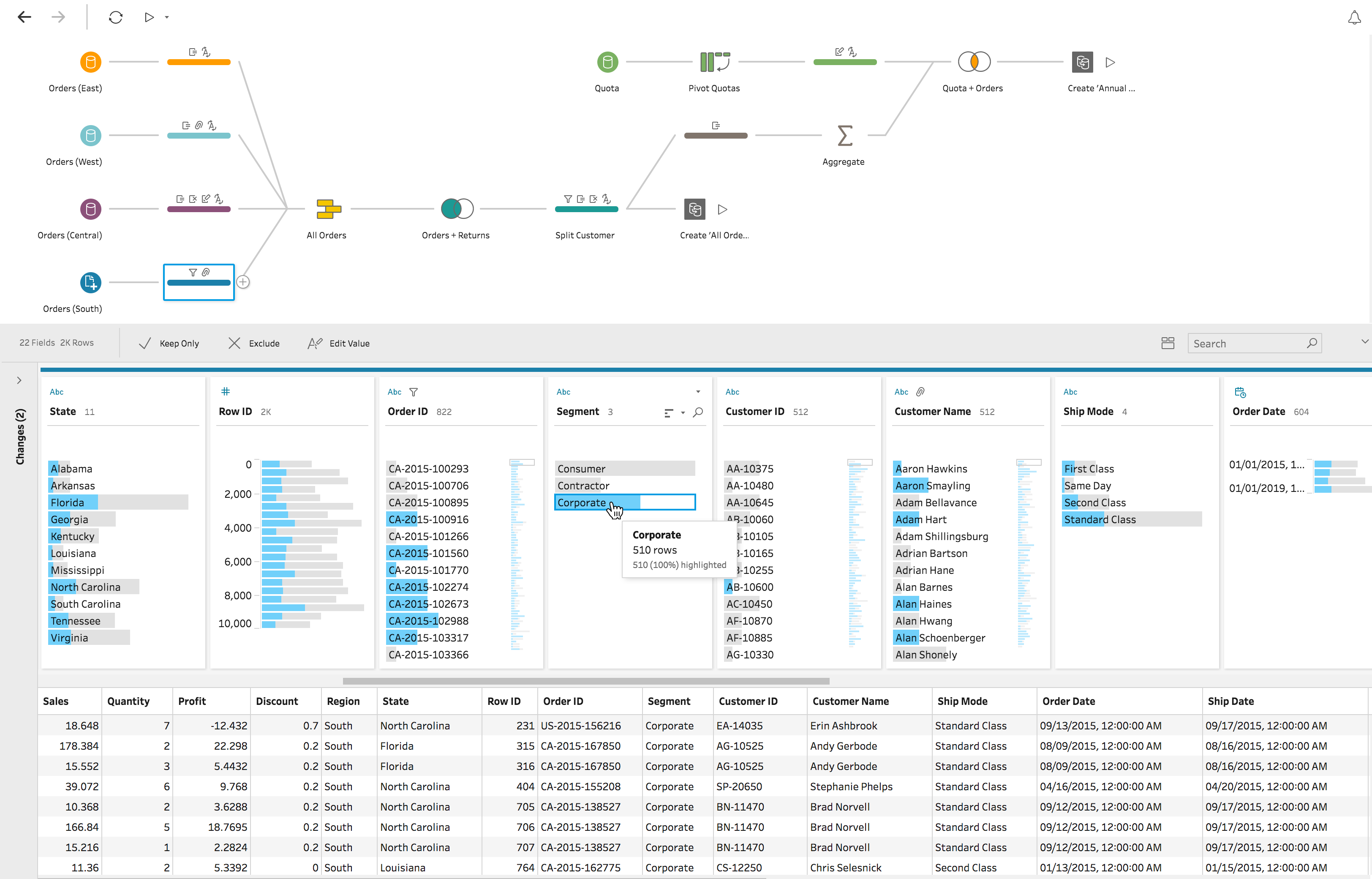
As for the new data preparation tool, the general idea here is to give users a visual way to shape and clean their data, something that’s especially important as businesses now often pull in data from a variety of sources. Tableau Prep can automate some of this, but the most important aspect of the service is that it gives users a visual interface for creating these kind of workflows. Prep includes support for all the standard Tableau data connectors and lets users perform calculations, too.

“Our customers often tell us that they love working with Tableau, but struggle when data is in the wrong shape for analysis,” said Francois Ajenstat, Chief Product Officer at Tableau. “We believe data prep and data analysis are two sides of the same coin that should be deeply integrated and look forward to bringing fun, easy data prep to everyone regardless of technical skill set.”

Monday, April 23, 2018

Heptio launches an open source load balancer for Kubernetes and OpenStack

Heptio is one of the more interesting companies in the container ecosystem. In part, that’s due to the simple fact that it was founded by Craig McLuckie and Joe Beda, two of the three engineers behind the original Kubernetes project, but also because of the technology it’s developing and the large amount of funding it has raised to date.

As the company announced today, it saw its revenue grow 140 percent from the last quarter of 2017 to the first quarter of 2018. In addition, Heptio says its headcount quadrupled since the beginning of 2017. Without any actual numbers, that kind of data doesn’t mean all that much. It’s easy to achieve high growth numbers if you’re starting out from zero, after all. But it looks like things are going well at the company and that the team is finding its place in the fast-growing Kubernetes ecosystem.

In addition to announcing these numbers, the team also today launched a new open source project that will join the company’s existing stable of tools like the cluster recovery tool Ark and the Kubernetes cluster monitoring tool Sonobuoy.

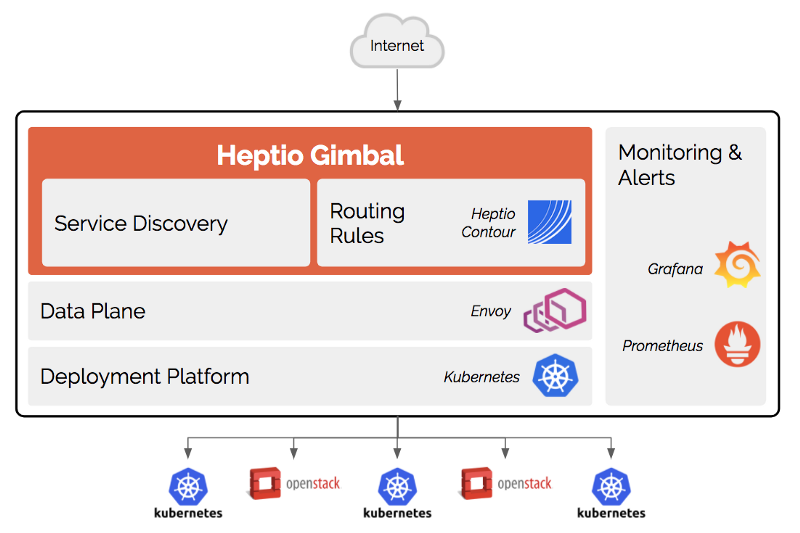
This new tool, Heptio Gimbal, has a very specific use case that is probably only of interest to a relatively small number of users — but for them, it’ll be a lifeline. Gimbal, which Heptio developed together with Yahoo Japan subsidiary Actapio, helps enterprises route traffic into both Kubernetes clusters and OpenStack deployments. Many enterprises now run these technologies in parallel and while some are now moving beyond OpenStack and toward a more Kubernetes-centric architecture, they aren’t likely to do away with their OpenStack investments anytime soon.

“We approached Heptio to help us modernize our infrastructure with Kubernetes without ripping out legacy investments in OpenStack and other back-end systems,” said Norifumi Matsuya, CEO and President at Actapio. “Application delivery at scale is key to our business. We needed faster service discovery and canary deployment capability that provides instant rollback and performance measurement. Gimbal enables our developers to address these challenges, which at the macro-level helps them increase their productivity and optimize system performance.”

Gimbal uses many of Heptio’s existing open source tools, as well as the Envoy proxy, which is part of the Cloud Native Computing Foundation’s stable of cloud-native projects. For now, Gimbal only supports one specific OpenStack release (the ‘Mitaka’ release from 2016), but the team is looking at adding support for VMware and EC2 in the future.

DoD clarifies winner-take-all cloud contract

When the Department of Defense announced in March, a 10-year winner-take-all cloud contract that could be worth up to $10 billion, it raised a few eyebrows. Last week, they clarified some of the conditions, and it turns out that much like a modern baseball free agent contract, there are a couple of points where the DoD can opt out of the deal.

In a press conference last week, chief Pentagon spokesperson, Dana W. White, indicated that the original contract award is for just two years. After that there are two additional options for five years and three years. The department can opt out after the first two years if it’s not working out, or seven years if it accepts the second option. Obviously if it takes the final option, that would add up to a full 10 year commitment.

Leigh Madden, who heads up Microsoft’s defense effort says he believes Microsoft can win such a contract, but it isn’t necessarily the best approach for the DoD. “If the DoD goes with a single award path, we are in it to win, but having said that it’s counter to what we are seeing across the globe where 80 percent of customers are adopting a multi-cloud solution,” Madden told TechCrunch.

White indicated that 46 companies have responded to the request for proposal, but it seems clear that there are only a handful of companies that could handle a project of this scope. For starters, we have Amazon and Microsoft along with Google, IBM and Oracle.

That said, White indicated that companies can band together and form a partnership, which means you could see some extremely strange bedfellows trying to form the equivalent of rock supergroup with multiple players coming together to win the deal.

This development certainly opens up some interesting options for the vendors involved and creates a level of competition and alliances, the likes of which the tech industry might have never seen. Whoever gets the contract, they get two years to prove they can do this, then they will be evaluated before getting a shot at the second five year window.

Slite raises $4.4M to create a smarter internal notes tool

Slack exposed the demand for a dead-simple internal communications tool, which has inspired a wave of startups trying to pick apart the rest of a company’s daily activities — including Slite, which hopes to take on internal notes with a fresh round of new capital.

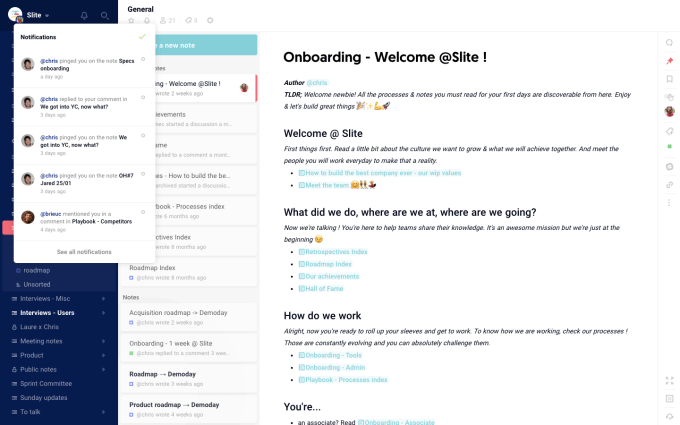
Slite is more or less an attempt at a replacement for a Google Doc or something in Dropbox Paper that is sprawling and getting a little out of control. An employee might create a Slite note like an onboarding manual or an internal contact list, and the hope is to replace the outdated internal wiki and offer employees a hub where they can either go and start stringing together important information, or find it right away. The company today said it has raised $4.4 million in a new seed funding round led by Index Ventures after coming out of Y Combinator’s 2018 winter class. Ari Helgason is joining Slite’s board of directors as part of the deal.

“We now have to develop this product enough to show we can actually replace large amounts of things,” co-founder Christophe Pasquier said. “Today we have more than 300 active teams, and we have to show that we can make it scale. In the short term is just we’re replacing Google Docs because these tools ahven’t evolved and we’re bringing something super fresh. The longer-term vision of really bringing all the information that has value from a team and becoming this single source of truth for teams.”

Slite tracks permissions and changes to the notes in order to allow companies to do a better job of maintaining them, rather than sharing around links and having different people jump in and make changes. The part about sharing links is one in particular that stung for Pasquier, as even larger companies can have issues with employees asking in Slack what policies are — or even for links to parts of the internal wiki where that important information is buried.

Getting there certainly won’t be easy. Companies like Dropbox continuing to invest in these kinds of collaborative note-taking tools — that could easily evolve into internal hubs of information. And as Pasquier tries to liken the development arc to Slack, which showed employees wanted some more seamless tool for communication, that company is also working on making its search tools smarter, like helping employees find the right person to ask a question. It doesn’t look like an asynchronous notes tool just yet, but if all the information is somewhere in Slack already, a smart search tool may be the only thing necessary to find all that information.

Saturday, April 21, 2018

Pivotal CEO talks IPO and balancing life in Dell family of companies

Pivotal has kind of a strange role for a company. On one hand its part of the EMC federation companies that Dell acquired in 2016 for a cool $67 billion, but it’s also an independently operated entity within that broader Dell family of companies — and that has to be a fine line to walk.

Whatever the challenges, the company went public yesterday and joined VMware as a  separately traded company within Dell. CEO Rob Mee says the company took the step of IPOing because it wanted additional capital.

“I think we can definitely use the capital to invest in marketing and R&D. The wider technology ecosystem is moving quickly. It does take additional investment to keep up,” Mee told TechCrunch just a few hours after his company rang the bell at the New York Stock Exchange.

As for that relationship of being a Dell company, he said that Michael Dell let him know early on after the EMC acquisition that he understood the company’s position. “From the time Dell acquired EMC, Michael was clear with me: You run the company. I’m just here to help. Dell is our largest shareholder, but we run independently. There have been opportunities to test that [since the acquisition] and it has held true,” Mee said.

Mee says that independence is essential because Pivotal has to remain technology-agnostic and it can’t favor Dell products and services over that mission. “It’s necessary because our core product is a cloud-agnostic platform. Our core value proposition is independence from any provider — and Dell and VMware are infrastructure providers,” he said.

That said, Mee also can play both sides because he can build products and services that do align with Dell and VMware offerings. “Certainly the companies inside the Dell family are customers of ours. Michael Dell has encouraged the IT group to adopt our methods and they are doing so,” he said. They have also started working more closely with VMware, announcing a container partnership last year.

Photo: Ron Miller

Overall though he sees his company’s mission in much broader terms, doing nothing less than helping the world’s largest companies transform their organizations. “Our mission is to transform how the world builds software. We are focused on the largest organizations in the world. What is a tailwind for us is that the reality is these large companies are at a tipping point of adopting how they digitize and develop software for strategic advantage,” Mee said.

The stock closed up 5 percent last night, but Mee says this isn’t about a single day. “We do very much focus on the long term. We have been executing to a quarterly cadence and have behaved like a public company inside Pivotal [even before the IPO]. We know how to do that while keeping an eye on the long term,” he said.

Up-and-coming enterprise startups in NYC

New York City has an incredible density of up-and-coming enterprise-focused startups. While the winners are publicized and well-known, we felt it was time to put a bit of a spotlight on younger companies, ones you may not have heard about yet, but are likely to in the coming years.

TechCrunch asked two dozen founders, venture capitalists, and other community members which companies — other than ones they are directly connected to — they thought were most likely to change the enterprise world in the coming years. From a list of 64 nominated startups, we chose twelve we thought best exemplified the potential for New York. All data on venture capital fundraised comes from Crunchbase. Also be sure to check out our in-depth profiles of NS1, Datadog, BigID, Packet, and Timescale as well as Security Scorecard, Uplevel, and HYPR, which were not included on this list.

In the NYC enterprise startup scene, security is job one

While most people probably would not think of New York as a hotbed for enterprise startups of any kind, it is actually quite active. When you stop to consider that the world’s biggest banks and financial services companies are located there, it would certainly make sense for security startups to concentrate on such a huge potential market — and it turns out, that’s the case.

According to Crunchbase, there are dozens of security startups based in the city with everything from biometrics and messaging security to identity, security scoring and graph-based analysis tools. Some established companies like Symphony, which was originally launched in the city (although it is now on the west coast), has raised almost $300 million. It was actually formed by a consortium of the world’s biggest financial services companies back in 2014 to create a secure unified messaging platform.

There is a reason such a broad-based ecosystem is based in a single place. The companies who want to discuss these kinds of solutions aren’t based in Silicon Valley. This isn’t typically a case of startups selling to other startups. It’s startups who have been established in New York because that’s where their primary customers are most likely to be.

In this article, we are looking at a few promising early-stage security startups based in Manhattan

Hypr: Decentralizing identity

Hypr is looking at decentralizing identity with the goal of making it much more difficult to steal credentials. As company co-founder and CEO George Avetisov puts it, the idea is to get rid of that credentials honeypot sitting on the servers at most large organizations, and moving the identity processing to the device.
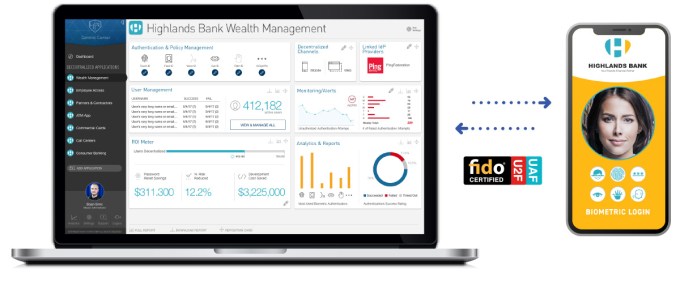
Hypr lets organizations remove stored credentials from the logon process. Photo: Hypr

“The goal of these companies in moving to decentralized authentication is to isolate account breaches to one person,” Avetisov explained. When you get rid of that centralized store, and move identity to the devices, you no longer have to worry about an Equifax scenario because the only thing hackers can get is the credentials on a single device — and that’s not typically worth the time and effort.

At its core, Hypr is an SDK. Developers can tap into the technology in their mobile app or website to force the authorization to the device. This could be using the fingerprint sensor on a phone or a security key like a Yubikey. Secondary authentication could include taking a picture. Over time, customers can delete the centralized storage as they shift to the Hypr method.

The company has raised $15 million and has 35 employees based in New York City.

Uplevel Security: Making connections with graph data

Uplevel’s founder Liz Maida began her career at Akamai where she learned about the value of large data sets and correlating that data to events to help customers understand what was going on behind the scenes. She took those lessons with her when she launched Uplevel Security in 2014. She had a vision of using a graph database to help analysts with differing skill sets understand the underlying connections between events.

“Let’s build a system that allows for correlation between machine intelligence and human intelligence,” she said. If the analyst agrees or disagrees, that information gets fed back into the graph, and the system learns over time the security events that most concern a given organization.

“What is exciting about [our approach] is you get a new alert and build a mini graph, then merge that into the historical data, and based on the network topology, you can start to decide if it’s malicious or not,” she said.
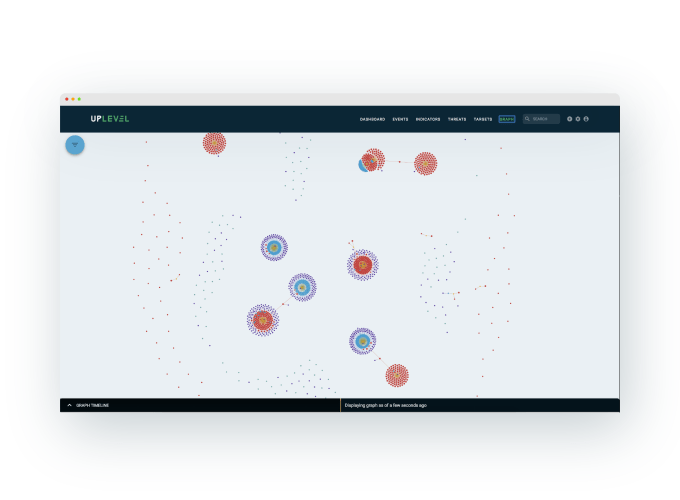
Photo: Uplevel

The company hopes that by providing a graphical view of the security data, it can help all levels of security analysts figure out the nature of the problem, select a proper course of action, and further build the understanding and connections for future similar events.

Maida said they took their time creating all aspects of the product, making the front end attractive, the underlying graph database and machine learning algorithms as useful as possible and allowing companies to get up and running quickly. Making it “self serve” was a priority, partly because they wanted customers digging in quickly and partly with only 10 people, they didn’t have the staff to do a lot of hand holding.

Security Scorecard: Offering a way to measure security

The founders of Security Scorecard met while working at the NYC ecommerce site, Gilt. For a time ecommerce and adtech ruled the startup scene in New York, but in recent times enterprise startups have really started to come on. Part of the reason for that is many people started at these foundational startups and when they started their own companies, they were looking to solve the kinds of enterprise problems they had encountered along the way. In the case of Security Scorecard, it was how could a CISO reasonably measure how secure a company they were buying services from was.

Photo: Security Scorecard

“Companies were doing business with third-party partners. If one of those companies gets hacked, you lose. How do you vett the security of companies you do business with” company co-founder and CEO Aleksandr Yampolskiy asked when they were forming the company.

They created a scoring system based on publicly available information, which wouldn’t require the companies being evaluated to participate. Armed with this data, they could apply a letter grade from A-F. As a former CISO at Gilt, it was certainly a paint point he felt personally. They knew some companies did undertake serious vetting, but it was usually via a questionnaire.

Security Scorecard was offering a way to capture security signals in an automated way and see at a glance just how well their vendors were doing. It doesn’t stop with the simple letter grade though, allowing you to dig into the company’s strengths and weaknesses and see how they compare to other companies in their peer groups and how they have performed over time.

It also gives customers the ability to see how they compare to peers in their own industry and use the number to brag about their security position or conversely, they could use it to ask for more budget to improve it.

The company launched in 2013 and has raised over $62 million, according to Crunchbase. Today, they have 130 employees and 400 enterprise customers.

If you’re an enterprise security startup, you need to be where the biggest companies in the world do business. That’s in New York City, and that’s precisely why these three companies, and dozens of others have chosen to call it home.